【1】Why Next-Generation Devices Are Needed
As miniaturization (scaling) approaches its limits, conventional MOSFETs face a growing set of challenges:
・Increasing leakage current
・Short-channel effects
・Deteriorating power efficiency
・Difficulty maintaining control due to quantum effects in electrons
・Worsening wiring and thermal issues
As a result, the semiconductor industry is increasingly shifting toward improving performance through fundamentally new operating principles, rather than continuing to rely on miniaturization alone.
This is precisely why next-generation devices matter so much.
【2】TFET (Tunnel Field-Effect Transistor)
2-1. Characteristics
・Uses the quantum tunneling effect in electrons to generate current.
・Capable of operating at ultra-low voltages, in the 0.2–0.4V range.
・Significantly reduces losses during switching.
・A leading candidate for low-power devices.
2-2. Benefits
・Low power consumption
・Low leakage current
・Well suited to servers, IoT devices, and wearables
2-3. Challenges
・Low ON current makes it poorly suited to high-performance logic applications.
・The technological foundation needed for large-scale mass production remains immature.
【3】Spin-FET (Spin Field-Effect Transistor)
A device application of spintronics
3-1. Characteristics
・Uses an electron’s spin, rather than its charge, to represent information.
・Controls not just the direction of current flow but also the orientation of spin (up or down).
・Can retain information even in a zero-power state.
3-2. Benefits
・Ultra-low power consumption
・High speed
・Non-volatility (state is retained even when power is turned off)
・Potential to merge memory and logic (processing-in-memory)
3-3. Example applications
・MRAM (already in mass production)
・Spin-injection-based logic
・Research into non-volatile processors
3-4. Challenges
・Low efficiency of spin injection
・The need to establish reliable materials and interface technologies
・Application to large-scale logic remains at the research stage
【4】Quantum Devices
4-1. Characteristics of the Qubit
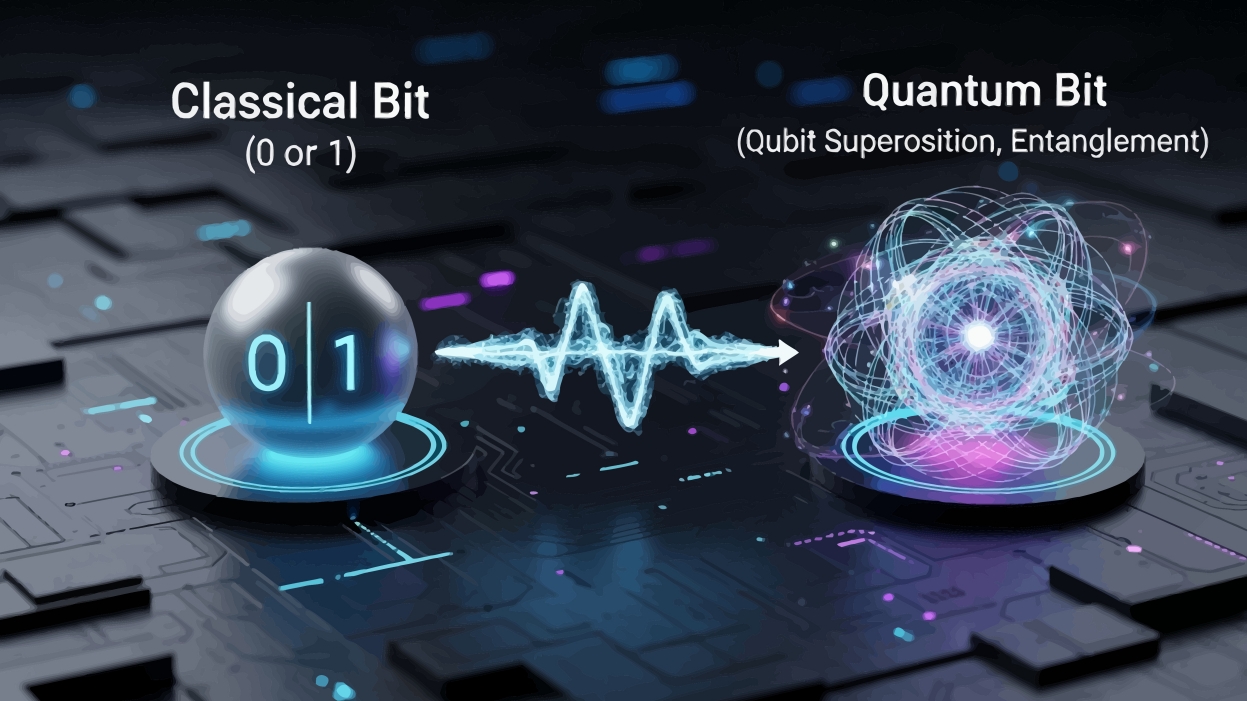
Unlike a conventional bit, which represents either 0 or 1, a quantum bit (qubit) can exist as a superposition of both 0 and 1 simultaneously.
This enables:
・A dramatic improvement in parallel computing performance
・Ultra-fast computation for certain specific problem domains
4-2. Types of Quantum Devices (Representative Examples)
・Superconducting qubits
・Quantum dot qubits
・Ion traps
・Photonic qubits (photonic quantum computers)
4-3. Applications
Quantum devices show particular promise in areas that remain difficult for conventional computers, including:
・Optimization problems
・The discovery of new materials
・Cryptanalysis
・Drug simulation
4-4. Challenges
・Cooling requirements (many designs require extremely low temperatures, around 20mK)
・The difficulty of error correction
・Large-scale practical use remains a distant goal
【5】Other Emerging Device Concepts
5-1. FeFET (Ferroelectric FET)
・Uses a ferroelectric material in the gate.
・Retains its state through polarization rather than stored charge.
・Offers high speed, non-volatility, and low power consumption.
・A promising candidate for merging next-generation memory and logic.
5-2. Photonic FETs / photonic logic
・Uses light rather than electrons.
・Generates little heat and is well suited to high-speed communications.
・Already seeing partial adoption in data centers.
5-3. 2D materials (graphene, MoS₂ FETs)
・Ultra-thin materials just one atomic layer thick.
・Enable extreme channel scaling.
・A candidate for what lies beyond GAA and CFET.
【6】A Summary of Next-Generation Devices
Semiconductor technology is expected to evolve along three main fronts going forward:
1.Lower power consumption (TFET, Spin-FET, FeFET)
2.Innovation in operating principles (quantum, photonic, spin-based)
3.Innovation in materials (2D materials, wide-bandgap materials)
Together, these advances are expected to enable continued performance improvement in a world beyond Moore’s Law.
Comprehension Check
1.What are the characteristics of the TFET?
2.Why is the Spin-FET well suited to low power consumption?
3.What is the greatest strength of quantum devices?
Column Supervisor: Koji Kakumoto (Otis Group Co., Ltd.)
After studying abroad and working in planning and development at a trading company, he joined Otis Group Co., Ltd. in 2011. While primarily working in the Corporate Planning Department, he has also served concurrently in manufacturing and technical divisions, and since 2018 has served as Representative Director, working to drive business growth and strengthen the organization.
This article is a general technical explanation intended for educational purposes and does not refer to any specific company, product, or technology.