
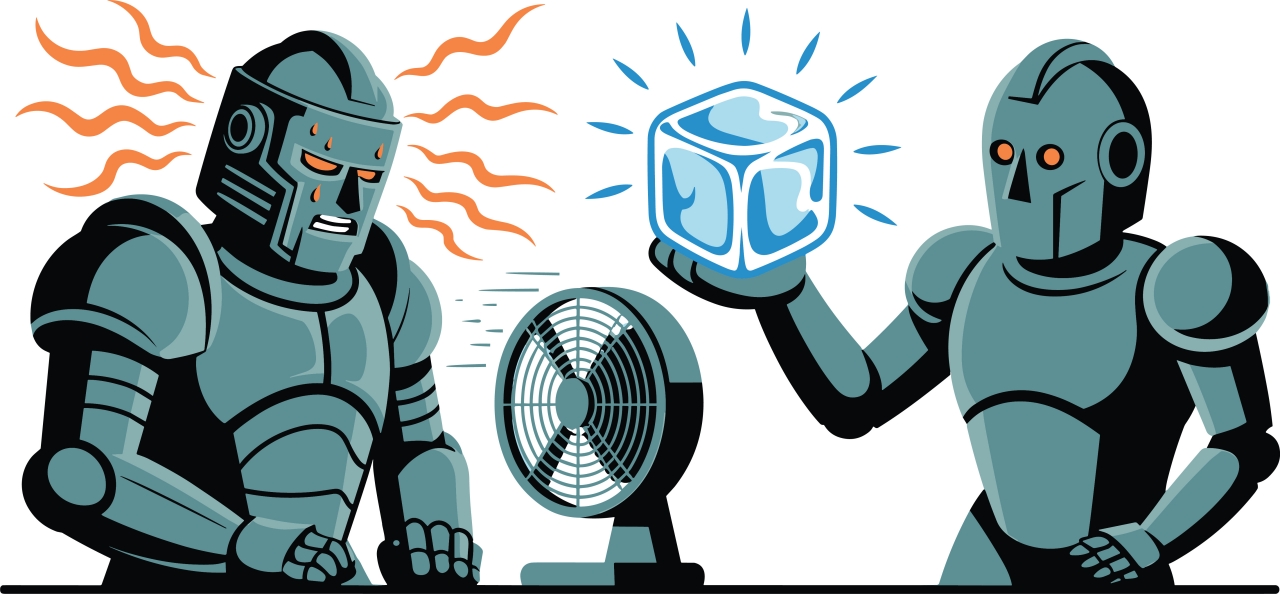
■ Robots Are Moving Heat Sources
Robots use far more energy than they appear to.
This is because they are a collection of heat sources, such as
● Motors
● Batteries
● Control boards
● AI computation
● Sensors
Humanoid robots in particular are required to be compact and move like humans.
In other words, they face thermally very demanding conditions:
● Small
● High power
● High density
● Long operating hours
■ Joints Are Especially Difficult
Among robot heat problems, what is thought likely to become especially important going forward is
the joints.
This is because joints concentrate
● Motors
● Gears
● Sensors
● Control systems
● Wiring
Moreover, making them move like humans requires
● Compactness
● High torque
● Fast response
In other words, a situation arises in which a part generates a lot of heat despite being small.
■ Why Heat Becomes a Problem
In robots, it is not simply a matter of getting hot.
For example,
● Lower motor efficiency
● Sensor errors
● Battery degradation
● Shorter component life
● Reduced lubrication performance
● Reduced control accuracy
can occur.
Furthermore, humanoid robots face the issue of touching people.
In other words, if they become too hot, this may lead to
● Low-temperature burns
● Discomfort
● Reduced safety
■ Robots Need to Be Cooled Quietly
What is interesting here is that large, simple cooling fans are difficult to use in robots.
This is because they are
● Noisy
● Heavy
● Increase power consumption
● Add moving parts
● Cannot be miniaturized
In other words, robots need to be cooled quietly and lightly, compactly, and safely.
This is extremely difficult.
■ The Robot Era Is an Era of Heat × Light Weight × Flexibility
Future robots will be required to be all of the following at once:
● Light
● Soft
● Safe for people
● Able to operate for long hours
● High power
In other words, from now on, it will become a complex problem of
heat × light weight × flexibility × safety.
This is extremely difficult.
■ Onboard AI Increases Heat Even Further
In addition, AI computation inside robots will increase from now on.
In other words, robots will simultaneously
● Move
● Think
● Recognize
● Communicate
internally.
This creates a state in which the brain and muscles generate heat at the same time.
This is highly likely to become a very major challenge for humanoid robots.
■ The Researcher's Perspective
Toward technology that moves while cooling
Current research includes
● High-efficiency motors
● Lightweight heat dissipation materials
● Flexible thermal materials
● Heat dissipation structures
● Compact liquid cooling
● Next-generation batteries
● AI-controlled thermal management
From now on, technology for not just moving but moving while controlling heat will become important.
■ The Shop-Floor Perspective
In robots, heat problems change with contact
On the shop floor, even more difficult problems arise.
For example,
● Narrow spaces inside joints
● Unstable contact at bending parts
● Interference with wiring
● Vibration
● Repetitive motion
● Contact between dissimilar materials
● Long-term durability
In other words, “it cools in theory” and
“it actually cools stably” are completely different.
■ The Robot Era Will Bring More Thin Functional Components
Future robots will require large numbers of components that are
● Thin
● Light
● Flexible
● Highly functional
For example, for
● Heat dissipation
● Insulation
● Noise suppression
● Cushioning
● Fixing
● Waterproofing
Moreover, these must be implemented with high precision in narrow spaces.
■ What Matters from OTIS's Perspective
From OTIS’s perspective, robot heat problems are not just a matter of cooling equipment.
What matters is
● Microfabrication
● Thin-film processing
● High-precision lamination
● Conformity to curved surfaces
● Weight reduction
● Contact between dissimilar materials
● Automated supply
● Volume production stability
In robots in particular,
because being small, thin, light, and soft is important,
the difficulty of the final 1mm of heat rises even further.
■ What OTIS Can Do
At OTIS, through
● Microfabrication
● High-precision die-cutting
● Thin-film processing
● High-precision lamination
● Processing of thermal management materials
● Processing of insulating materials
● Processing of materials that conform to curved surfaces
● Support for automated supply
we may be able to contribute to making functional components usable inside robots work in volume production.
■ Outside OTIS's Expertise
On the other hand, OTIS is not a company that specializes in
● Robot design
● Motor development
● AI control development
● Battery development
● Robot OS development
However, in the area of making functional components work in volume production processes, we may be able to play an important role.
■ Summary
The future of robots will be decided by coexistence with heat
Future robots will move
● More like humans
● More compactly
● With more power
● For longer hours
Behind the scenes, however, heat will become a major constraint.
In other words, future robot competition may be decided not only by how smartly they move,
but also by how well heat can be made to work.
And behind the scenes, technologies that support the final 1mm of heat will become increasingly important.
Column Supervisor: Koji Kakumoto (President, OTIS Co., Ltd.)
After studying abroad and working in planning and development at a trading company, he joined OTIS Co., Ltd. in 2011. While primarily working in the Corporate Planning Department, he has also served concurrently in manufacturing and technical divisions, and since 2018 has served as President, working to drive business growth and strengthen the organization.
This article is a general technical explanation intended for educational purposes and does not refer to any specific company, product, or technology.


