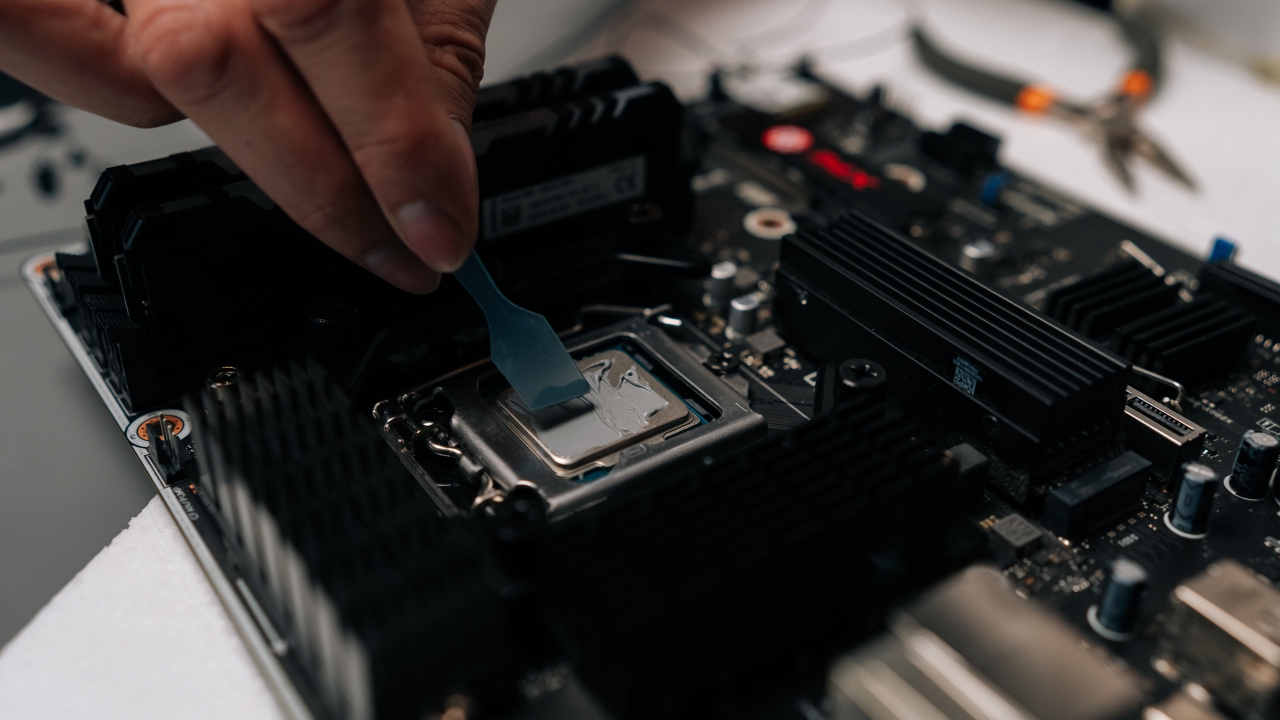
■ Why TIM Is Needed
If you stack a heat-generating component directly on a heat-dissipating component, it may seem that heat will simply flow through.
In reality, however, a perfectly flat surface does not exist.
Even if the surfaces of metals and resins look flat at first glance, they have fine irregularities at the microscopic level.
That is why, even when components are stacked, they are not in close contact over the entire surface.
In reality, there are parts that are in contact and parts that are not in contact.
And air gets into the parts that are not in contact.
■ TIM's Biggest Role Is to Reduce Air Layers
What is extremely important in thermal management is air layers.
Air does not conduct heat well.
That is why even a slight air layer between a heat-generating component and a heat-dissipating component makes it harder for heat to flow.
The essential role of TIM is to fill in this air layer.
In other words, TIM is not simply a “material that conducts heat.”
It is a material that reduces the air that obstructs heat.
Understanding this is the first step in understanding TIM.
■ TIM Is a Material That Lowers Contact Thermal Resistance
At the boundary between a heat-generating component and a heat-dissipating component, heat has difficulty flowing.
This is called contact thermal resistance.
TIM is used to lower this contact thermal resistance.
In other words, the purpose of TIM is to keep heat from stopping between one material and another.
In thermal management, not only the thermal conductivity of a material alone, but also the thermal resistance at this interface is extremely important.
■ Types of TIM
There are various types of TIM.
Typical examples are as follows.
● Thermally conductive sheets
● Thermal grease
● Thermally conductive gels
● Gap fillers
● Phase change materials
● Thermally conductive adhesives
● Thermally conductive putty
Each has its own characteristics and is used selectively depending on the application.
■ Thermally Conductive Sheets
Thermally conductive sheets are sheet-type TIMs.
Their thickness is easy to control and they are easy to process, so they are easy to use in volume production applications.
They are also well suited to die-cutting and lamination.
On the other hand, when the surface irregularities of components are large or the pressure conditions are insufficient, sufficient adhesion may not be obtained.
That is why, with thermally conductive sheets,
thickness
softness
compressibility
lamination state are important.
■ Thermal Grease
Thermal grease is a paste-type TIM.
Because it is soft, it easily penetrates fine gaps and easily lowers contact thermal resistance.
It is often used around CPUs and GPUs.
On the other hand, there are challenges such as
● Controlling the amount applied
● Squeeze-out
● Pump-out
● Aging degradation
● Work variation
In volume production processes, application conditions and control methods are important.
■ Thermally Conductive Gels and Gap Fillers
Thermally conductive gels and gap fillers are used to fill gaps between components.
Because they are soft and deform easily, they easily absorb steps and tolerances.
They are important in AI servers, automotive equipment, power supply equipment, around EV batteries, and so on.
On the other hand, as the thickness increases, thermal resistance also tends to increase.
That is why the balance between filling gaps and
not increasing thermal resistance too much is important.
■ Phase Change Materials
Phase change materials are TIMs whose state changes with temperature.
Above a certain temperature, they soften and conform more easily to the contact surface.
This reduces air layers at the interface and makes it easier for heat to flow.
However, the operating temperature, heating conditions, repeated-cycle reliability, and so on must be considered.
■ Choosing TIM by Thermal Conductivity Alone Leads to Failure
There is a common misconception in TIM selection.
That is the idea that the higher the thermal conductivity of a TIM, the more surely it will cool.
This is not necessarily correct.
Of course, thermal conductivity is important.
However, actual thermal performance is not determined by thermal conductivity alone.
Actual heat dissipation performance changes greatly depending on
● Thickness
● Adhesion
● Compressibility
● Surface conformability
● Pressure conditions
● Presence of air bubbles
● Changes over time
● Volume production variation
In some cases, a material that adheres well may cool better in actual use than a material with high thermal conductivity.
■ With TIM, Thinner Is Not Always Better
The thinner the TIM, the easier it is to lower thermal resistance.
However, if it is too thin, it may not be able to absorb irregularities and tolerances between components.
As a result, air layers remain and contact thermal resistance increases.
In other words, with TIM,
the balance between thinness and the ability to fill gaps is important.
■ Softness Is Also Important for TIM
TIM must conform to the irregularities of component surfaces.
That is why softness and compressibility are important.
A TIM that is too hard cannot conform to surface irregularities, and air layers may remain.
On the other hand, materials that are too soft may have problems with shape retention and long-term reliability.
In other words, TIM is a material for which not only thermal conductivity
but also mechanical properties are important.
■ TIM Is Important in AI Servers
In AI servers, GPUs and AI semiconductors generate a large amount of heat.
TIM is important for releasing that heat to cooling plates and heat sinks.
In AI servers in particular,
● High heat generation
● High-density mounting
● Continuous operation
● The shift to liquid cooling
● Maintainability
● Long-term reliability
are required.
That is why TIM is required not only to have good initial performance, but also to keep heat flowing stably over long periods.
■ TIM Is Also Important in EVs and Batteries
In EVs and ESS, heat must be controlled between battery cells, cooling plates, insulating materials, enclosures, and so on.
TIMs and gap fillers are used here as well.
However, in EVs and ESS, not only heat dissipation but also
● Electrical insulation
● Flame retardancy
● Vibration resistance
● Compression conformability
● Long-term reliability
● Safety during thermal runaway
are important.
In other words, with TIM for EVs and ESS, releasing heat and
ensuring safety must be considered at the same time.
■ TIM Is Also Important in 3D Semiconductors
In 3D semiconductors, chips and memory are arranged at high density.
Then the escape routes for heat become complex.
At this point, if heat stops at the interfaces of each layer or component, localized temperature rises occur.
In other words, in 3D semiconductors, the role of TIM and interface materials becomes even more important.
In future semiconductor packaging, not only circuit design
but also interface design that releases heat will be important.
■ The Researcher's Perspective: TIM Is a Materials Technology and an Interface Technology
In research and development, the following kinds of performance are required of TIM.
● High thermal conductivity
● Low thermal resistance
● Flexibility
● Compression conformability
● Electrical insulation
● Long-term reliability
● Heat resistance
● Flame retardancy
● Low outgassing
However, essentially, TIM is not a technology of the material alone.
It is a technology of how to make the interface between materials work.
■ The Shop-Floor Perspective: TIM Performance Changes with How It Is Used
TIM performance is not determined just by selecting it.
In reality, performance changes depending on
● What shape it is processed into
● What thickness it is made
● Where it is applied
● What pressure it is compressed with
● Whether air bubbles get in
● Whether it shifts in automated processes
● Whether contact is maintained after aging
In other words, TIM performance is determined not only by material performance,
but by mounting quality.
■ Problems That Tend to Occur in Volume Production of TIM
On the volume production floor, the following kinds of problems can occur with TIM.
● Burrs during die-cutting
● Particle shedding
● Shape misalignment
● Lamination misalignment
● Thickness variation
● Air bubble entrapment
● Deformation during transport
● Compatibility with release liners
● Jamming during supply to automated machines
● Deformation or changes in adhesion during storage
When these occur, they affect not only thermal performance but also ease of assembly and yield.
In other words, with TIM, rather than buying the material,
making it into a form that can be used stably in volume production is what matters.
■ OTIS's Perspective
OTIS is not a company that develops TIM materials themselves.
However, we may be able to contribute in the area of processing TIM into a form that can be used in volume production processes.
What matters from OTIS’s perspective is
● Processing into the intended shape
● Handling at the intended thickness
● Supporting fine shapes
● Increasing lamination accuracy
● Laminating with dissimilar materials
● Creating supply formats suited to automated processes
● Suppressing variation in volume production
TIM is a material and, at the same time, a process component.
That is why how to bring TIM into volume production processes is important.
■ What OTIS Can Do
At OTIS, through
● Processing of thermally conductive sheets
● Die-cutting of heat dissipation sheets
● Processing of insulating heat dissipation materials
● High-precision die-cutting
● Microfabrication
● High-precision lamination
● Irregular-shape processing
● Lamination of dissimilar materials
● Reel supply
● Designing supply formats for automated processes
and more, we may be able to contribute to bringing TIM closer to a state in which it can be used in volume production.
Especially in AI servers, EVs, ESS, 3D semiconductors, and the like, the accuracy, thickness, lamination, and supply format of thermal management components are important.
■ Outside OTIS's Expertise
On the other hand, OTIS is not a company that specializes in
● TIM material formulation
● Filler development
● Resin design
● Development of material properties themselves
● Dedicated thermal simulation analysis
● Cooling equipment design
However, in the area of making TIM into a form that can be used in volume production processes,
we may be able to play an important role.
■ Industries Where This Technology Will Be Important
★★★★★ AI servers
★★★★★ GPUs and semiconductors
★★★★★ EVs and batteries
★★★★★ ESS and energy storage systems
★★★★☆ Data centers
★★★★☆ 3D semiconductors
★★★★☆ Robots
■ Summary
TIM is not a material that conducts heat, but a material that makes the interface work
TIM is a thermally conductive interface material used between heat-generating components and heat-dissipating components.
However, the essence of TIM is not simply a material with high thermal conductivity.
The essence is
reducing air layers
lowering contact thermal resistance
making the interface between materials work.
That is why choosing TIM by thermal conductivity alone can lead to failure.
Thickness, softness, compressibility, contact state, and volume production stability must all be considered.
In future industries such as AI servers, EVs, ESS, and 3D semiconductors, the more heat generation density rises, the more important TIM will become.
And it is not enough for TIM to be excellent as a material.
Only when it takes a form that can be used correctly in volume production processes does it become thermal management.
This is where OTIS may be able to contribute.
Column Supervisor: Koji Kakumoto (President, OTIS Co., Ltd.)
After studying abroad and working in planning and development at a trading company, he joined OTIS Co., Ltd. in 2011. While primarily working in the Corporate Planning Department, he has also served concurrently in manufacturing and technical divisions, and since 2018 has served as President, working to drive business growth and strengthen the organization.
This article is a general technical explanation intended for educational purposes and does not refer to any specific company, product, or technology.