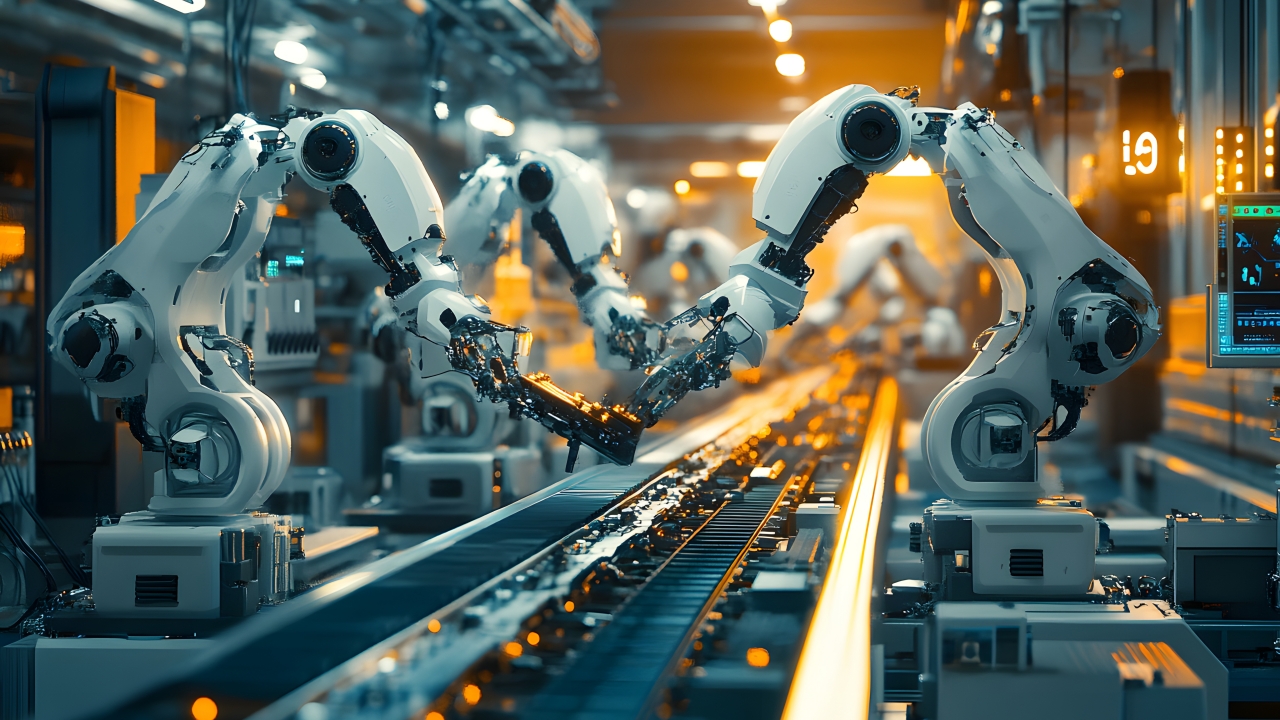
■ Factory Equipment Contains Many Heat Sources
Factory equipment and automation systems have many heat sources.
● Motors
● Servos
● Inverters
● Control panels
● Power supplies
● Lighting for image inspection
● Cameras
● Sensors
● Heaters
● Pneumatic equipment
● Transport mechanisms
● Friction parts
These run for long periods.
Moreover, on the volume production floor, it is not enough to run for just a few minutes.
From morning to night.
In some cases, 24 hours a day.
They must keep running with the same accuracy.
That is why heat problems in equipment appear not as short-term heat generation,
but as heat accumulation due to long-term operation.
■ Heat Changes Equipment Accuracy
What is frightening about factory equipment is that heat changes the dimensions and positions of the equipment itself.
Metal expands when its temperature rises.
Resin also deforms with temperature.
Jigs, frames, and transport sections also change subtly.
Then
● Positional misalignment
● Dimensional deviation
● Lamination misalignment
● Die-cutting position misalignment
● Transport misalignment
● Inspection position misalignment
occur.
In other words, heat may change the accuracy of the equipment itself.
■ In High-Precision Processing, Slight Thermal Changes Matter
In general processing, some temperature change may be acceptable.
In high-precision processing, however, things are different.
Tens of μm.
In processes that require accuracy at that level or even finer, slight thermal expansion or jig deformation becomes a problem.
In other words, in high-precision volume production, heat affects dimensional tolerances.
■ As Equipment Warms Up, Its State Differs Between Morning and Afternoon
On the shop floor, the state of equipment often differs between first thing in the morning and the afternoon onward.
A state in which the equipment is cold.
A state in which it has warmed up from running continuously.
A state in which the room temperature has risen.
A state in which motors and control panels have generated heat.
Because of these, even if you think you are running it under the same conditions, the state of the equipment has actually changed.
In other words, on the volume production floor, thermal changes until the equipment stabilizes must also be considered.
■ Heat Also Affects Materials
It is not just the equipment.
The materials being processed are also affected by heat.
In particular,
● Films
● Tapes
● Adhesive materials
● Foam materials
● Resin sheets
● Thin-film materials, and so on tend to change state with temperature and humidity.
Materials stretch.
Adhesive strength changes.
Peelability changes.
Warping occurs.
Transport tension changes.
In other words, heat problems in factory equipment appear not only on the equipment side,
but also on the material side.
■ Adhesive Materials Change with Heat
Adhesive materials in particular are easily affected by heat.
When the temperature rises,
● Adhesive strength changes
● They become softer
● Adhesive residue increases
● They become harder to peel
● Conversely, holding power drops
In other words, in processes using adhesive materials, heat may change the processing conditions themselves.
■ In Automation Systems, Stable Transport Breaks Down Due to Heat
In automation systems, it is important to transport materials stably.
However, when heat changes the state of materials,
● Meandering
● Wrinkles
● Lifting
● Positional misalignment
● Peeling defects
● Winding defects
can occur.
In other words, heat problems in automation systems are not the simple matter of the equipment being hot.
It is also a problem of materials no longer flowing stably.
■ Image Inspection Is Also Affected by Heat
Image inspection equipment is also affected by heat.
For example, inspection conditions can change due to
● Heat generated by lighting
● Temperature around cameras
● Thermal changes in lenses
● Thermal deformation at the workpiece position
● Expansion of the equipment frame
Then this may lead to
● Focus deviation
● Positional misalignment
● Changes in brightness
● Misjudgments
● Missed defects
In other words, heat affects not only processing accuracy,
but also inspection accuracy.
■ Heat in Control Panels Cannot Be Ignored Either
In factory equipment, heat in control panels is also important.
Inside control panels are
● PLCs
● Power supplies
● Servo amplifiers
● Inverters
● Relays
● Communication equipment, and so on.
These generate heat.
When the inside of a control panel gets hot, it leads to shorter electronic component life and risk of malfunction.
In other words, in thermal management for equipment, not only the product processing section
but also the control section must be looked at.
■ The Factory Environment Itself Also Becomes a Thermal Condition
On the volume production floor, not only the equipment alone but also the factory environment is important.
Process conditions can change due to
● Room temperature
● Humidity
● Air conditioning
● Equipment layout
● Sunlight
● Exhaust heat
● Workers coming and going
● Heat generated by surrounding equipment
In other words, heat problems in factory equipment are not only a problem inside the equipment,
but also an environmental problem of the entire factory.
■ Heat Breaks Reproducibility
The most frightening thing in volume production is that reproducibility breaks down.
Yesterday it was fine.
In the morning it was fine.
An hour ago it was fine.
But now it is off.
Heat is sometimes involved behind such phenomena.
The equipment warms up.
Materials change.
Jigs expand.
Adhesion changes.
Lighting changes.
As a result, process conditions change little by little.
In other words, heat becomes a factor that breaks the reproducibility of volume production.
■ AI and Automation Will Increase Heat Problems
From now on, more AI and image processing will go into factory equipment.
● AI visual inspection
● Image recognition
● Automatic correction
● Robot control
● Sensor monitoring
● Real-time quality control
As these increase, the electronic components and computing devices inside equipment also increase.
In other words, factory equipment is moving from mechanical devices
closer to moving computers.
As a result, heat sources may increase even further.
■ The Researcher's Perspective: Thermal Deformation and Thermal Stability Become Important in Factory Equipment
In research and development and in equipment design,
● Thermal expansion
● Thermal deformation
● Heat dissipation design
● Control panel cooling
● Temperature control
● Thermal simulation
● Temperature monitoring with sensors
● State prediction by AI, and so on become important.
The more equipment advances toward higher precision,
the more how to suppress temperature changes
and how to compensate for temperature changes become important.
■ The Shop-Floor Perspective
Heat throws off condition setting
On the shop floor, condition setting is extremely important.
Processing pressure.
Speed.
Tension.
Lamination position.
Peeling angle.
Transport conditions.
Inspection conditions.
However, when heat changes materials and equipment, the conditions you worked hard to set change.
In other words, on the shop floor, if you set conditions without looking at heat, reproducibility may break down.
■ OTIS's Perspective
From OTIS’s perspective, what matters in heat problems for factory equipment and automation systems is
● High-precision processing
● Material transport stability
● Lamination accuracy
● Tension management
● Peelability management
● Supply formats for automation
● Jig design
● Tolerance management in volume production
● Understanding material changes due to temperature
● Process feasibility
Especially with films, tapes, and thin-film materials,
it is important to recognize that the thinner the material, the more susceptible it is to heat and environmental effects.
■ What OTIS Can Do
At OTIS, for thermally conductive sheets such as graphite and metal, through
● High-precision die-cutting
● Microfabrication
● High-precision lamination
● Film and tape processing
● Adhesive material processing
● Reel supply
● Designing supply formats for automated processes
● Stacking of irregular shapes
● Condition design in volume production processes
and more, we may be able to contribute to making components that are easy to use in factory equipment and automated processes.
In particular, making them into a form that can be used stably in customers’ automated processes is an area where OTIS can deliver value.
■ Outside OTIS's Expertise
On the other hand, OTIS is not a company that specializes in
● Air conditioning design for entire factories
● Overall equipment design as an equipment manufacturer
● Control panel cooling design
● AI control software development
● Factory energy management
However, in the area of making films, tapes, and functional components used in automated processes work in volume production,
we may be able to play an important role.
■ Industries Where This Technology Will Be Important
★★★★★ Automation equipment
★★★★★ High-precision processing equipment
★★★★★ Film and tape processing processes
★★★★☆ Image inspection equipment
★★★★☆ Robotic transport equipment
★★★★☆ Semiconductor and electronic component manufacturing processes
■ Summary
In factory equipment, heat breaks volume production reproducibility
Heat problems in factory equipment and automation systems are not simply a matter of the equipment getting hot.
Heat may cause
● Equipment accuracy to change
● Material states to change
● Adhesive properties to change
● Transport to change
● Inspection conditions to change
● Volume production reproducibility to break down
In other words, on the volume production floor, thermal management is quality management,
and thermal management is also process stabilization.
No matter how good the materials or how good the equipment, if heat changes the conditions, stable volume production becomes difficult.
That is precisely why, in future automated processes,
process design that assumes heat will become increasingly important.
Column Supervisor: Koji Kakumoto (President, OTIS Co., Ltd.)
After studying abroad and working in planning and development at a trading company, he joined OTIS Co., Ltd. in 2011. While primarily working in the Corporate Planning Department, he has also served concurrently in manufacturing and technical divisions, and since 2018 has served as President, working to drive business growth and strengthen the organization.
This article is a general technical explanation intended for educational purposes and does not refer to any specific company, product, or technology.