■ What Is Contact Resistance?
Contact resistance is resistance that arises where materials are in contact with each other.
In the field of heat, it is called contact thermal resistance.
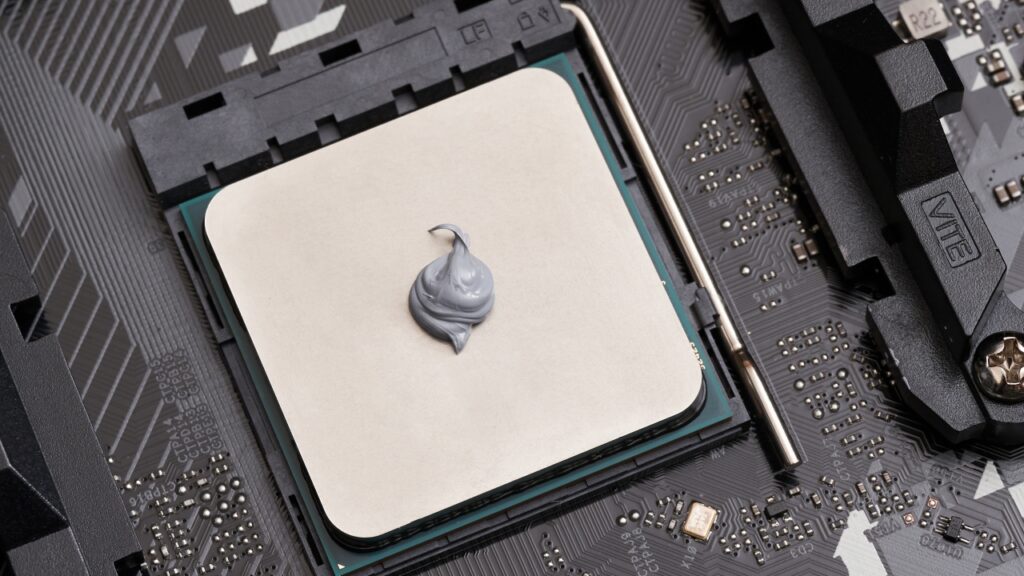
For example, there is a structure such as
Heat-generating component
↓
TIM
↓
Heat sink
At this point, heat moves from the heat-generating component to the TIM, and from the TIM to the heat sink.
However, heat can have difficulty flowing at those boundaries.
This difficulty of flowing at the boundary is contact thermal resistance.
■ They Seem to Be in Contact, but Are Not in Contact over the Entire Surface
When components are stacked, they appear to be in close contact.
In reality, however, they are not completely in contact.
Metal surfaces, resin surfaces, and film surfaces all have irregularities at the microscopic level.
That is why only part of the surface is actually in contact.
Air gets into the rest.
And air conducts heat poorly.
In other words, even if they appear to be in contact, they may not be in contact thermally.
■ Air Layers Stop Heat
The most important thing in thinking about contact resistance is air layers.
Air conducts heat extremely poorly.
That is why even a slight air layer between a heat-generating component and a heat-dissipating component makes it harder for heat to flow.
In other words, the essence of contact thermal resistance is that air remains in the parts that are not in contact.
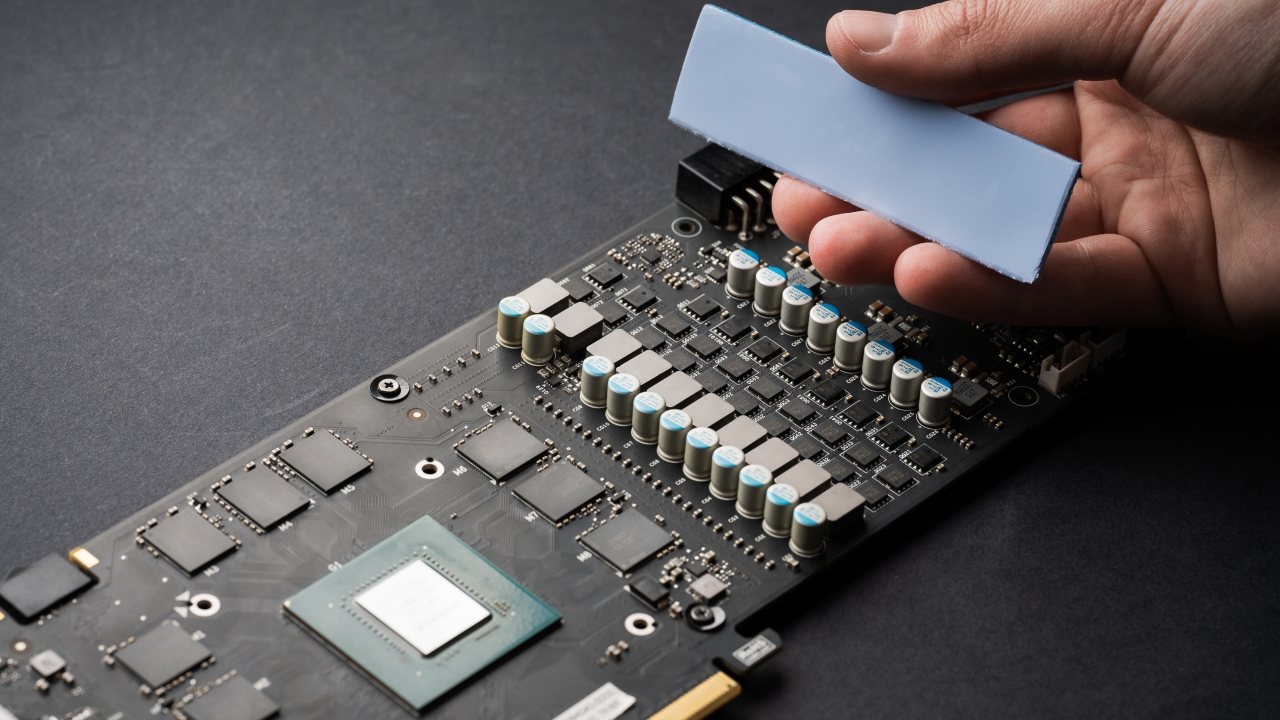
TIM, gels, greases, heat dissipation sheets, and so on are used to reduce this air layer.
■ TIM Is Used to Lower Contact Resistance
TIM is short for Thermal Interface Material.
It is placed between heat-generating components and heat-dissipating components to lower contact thermal resistance.
The role of TIM is not simply to have high thermal conductivity.
Essentially, it is to fill air layers.
In other words, TIM is a material that conducts heat and, at the same time,
a material that makes contact work.
■ When Pressure Is Insufficient, Contact Resistance Increases
Contact thermal resistance changes with pressure.
When components are pressed together sufficiently, the contact area increases and air layers decrease.
As a result, heat flows more easily.
On the other hand, when pressure is insufficient, the contact area becomes smaller and air layers remain.
In other words, insufficient pressure can destroy thermal performance.
However, it is not simply a matter of applying pressure.
If the pressure is too strong, components may deform or crack, or stress may concentrate.
■ Softness Helps Contact
Soft materials easily conform to surface irregularities.
That is why they can be advantageous in lowering contact thermal resistance.
For example, gels and greases easily penetrate fine gaps.
On the other hand, hard materials may fail to conform to the surface even if their thermal conductivity is high, leaving air layers.
In other words, rather than a material with high thermal conductivity but hard,
a material that adheres well even if its thermal conductivity is slightly lower may actually cool better.
■ However, Being Too Soft Is Also a Problem
Soft materials are advantageous for contact.
However, if they are too soft, other problems arise.
● Squeezing out
● Deforming
● Unstable thickness
● Shifting position
● Being crushed by long-term compression
● Being hard to handle in automated processes
In other words, softness is important for lowering contact thermal resistance, but in volume production, shape stability is also necessary.
With thermal management materials, the balance between softness and ease of handling is important.
■ Greater Thickness Helps Contact, but Increases Thermal Resistance
The thicker a TIM or heat dissipation sheet is, the more easily it absorbs steps and tolerances.
In other words, it becomes easier to make contact work.
However, as thickness increases, the thermal resistance inside the material also tends to increase.
In other words, there is a contradiction: thicker is advantageous for contact,
but thinner is advantageous for thermal resistance.
If this balance is wrong, it will not cool as expected.
■ Surface Roughness Changes Contact Resistance
The surface condition of the components in contact is also important.
When a surface is rough, the actual contact area tends to decrease.
Even if a surface is too smooth, adhesion can be difficult depending on compatibility with the material.
In other words, contact thermal resistance is affected not only by the TIM side but also by the surface condition of the mating material.
In thermal management, it is necessary to look not only at the heat dissipation material, but also at the surface of the mating component.
■ Lamination Misalignment Increases Contact Resistance
Thermal management components function only when placed in the correct position.
If the application position shifts, they may not make sufficient contact with the heat-generating component.
In addition, if the edges lift or ride up on steps, air layers form.
In other words, lamination misalignment not only takes the material off the escape route for heat,
but also causes increased contact thermal resistance.
■ Foreign Matter Destroys Contact
When there is foreign matter on the contact surface, the component lifts.
For example,
● Die-cut scrap
● Metal particles
● Graphite particles
● Dust
● Film fragments
● Adhesive squeeze-out, and so on.
When foreign matter lifts part of the component, an air layer forms there.
As a result, heat has difficulty flowing.
In other words, in thermal management, foreign matter management is also a contact resistance countermeasure.
■ Thermal Expansion Changes the Contact State
When temperature rises, materials expand.
However, expansion rates differ depending on the material.
Metals, resins, ceramics, adhesive materials, and graphite move differently in response to temperature changes.
That is why, even if they are in contact in the initial state, temperature changes can cause
● Lifting
● Peeling
● Warping
● Stress concentration
● Reduced pressure
In other words, contact thermal resistance changes not only in the initial state but also during use.
■ In AI Servers, Contact Resistance Limits Performance
In AI servers, GPUs and AI semiconductors generate large amounts of heat.
To release that heat to cooling plates and liquid cooling components, the thermal resistance at the interfaces must be low.
However, if the contact state is poor, heat will not flow no matter how high-performance the cooling equipment is.
As a result, it leads to
● Temperature rise
● Thermal throttling
● Reduced performance
● Reduced long-term reliability
In other words, in AI servers, not only cooling capacity,
but also contact capacity is important.
■ In EVs and ESS, Contact Resistance Changes Lifespan
In EVs and ESS, contact between battery cells and cooling components is important.
When the contact state varies, temperature differences between cells increase.
When temperature differences are large, degradation rates also differ.
As a result, it may lead to
● Shorter battery life
● Reduced output
● Variation between cells
● Reduced safety
In other words, in EVs and ESS, variation in contact resistance
can become variation in lifespan.
■ In Smartphones and Wearables, It Affects Perceived Temperature
In smartphones and wearable devices, even slight poor contact can cause temperature unevenness.
When heat builds up locally, users feel it as hot.
Especially in wearable devices, because they are close to the human body, even a small temperature difference leads to discomfort.
In other words, in small devices, contact resistance
affects perceived quality.
■ The Researcher's Perspective
Contact thermal resistance is not a material property but an interface property
In research and development, the thermal conductivity of materials alone attracts attention.
However, contact thermal resistance is not determined by the material alone.
Contact thermal resistance is determined by the combination of
● Material A
● Material B
● Surface roughness
● Pressure
● Interface material
● Thickness
● Temperature
● Changes over time
In other words, contact thermal resistance must be thought of not as a material property,
but as an interface property.
■ The Shop-Floor Perspective: The Cause of Not Cooling Is Often That Things Are Not in Contact
On the shop floor, it is necessary to look at the contact state before changing materials.
Even if high-performance materials are used, if
● It is lifting
● There are air bubbles
● Pressure is insufficient
● There is foreign matter
● The application position is misaligned
● The surfaces do not match
it will not cool.
In other words, the cause of not cooling may be not the material, but
the fact that things are not in contact.
■ Problems That Tend to Occur with Contact Resistance
In volume production processes, the following kinds of problems can occur.
● Uneven compression bonding
● Air bubble entrapment
● Foreign matter caught in
● Application misalignment
● Thickness variation
● Edge lifting
● Peeling
● Warping due to thermal expansion
● Compression set
● Reduced contact after aging
These can affect not only thermal performance but also insulation, waterproofing, noise, and durability.
■ OTIS's Perspective
OTIS is not a company that develops thermal materials themselves.
However, we may be able to contribute in the area of processing that makes the contact state of thermal management materials work in volume production.
What matters from OTIS’s perspective is
● High-precision die-cutting
● High-precision lamination
● Thickness control
● Lamination of dissimilar materials
● Combination with adhesive materials
● Release liner design
● Supply formats for automated processes
● Lamination accuracy
● Foreign matter management
Contact thermal resistance does not go down through material selection alone.
Processing into a form that makes correct contact is important.
■ What OTIS Can Do
At OTIS, through
● TIM processing
● Heat dissipation sheet processing
● Graphite processing
● Insulating material processing
● Adhesive material processing
● High-precision die-cutting
● Microfabrication
● High-precision lamination
● Lamination of dissimilar materials
● Reel supply
● Designing supply formats for automated processes
and more, we may be able to contribute to stabilizing the contact state of thermal management components in volume production.
■ Outside OTIS's Expertise
On the other hand, OTIS is not a company that specializes in
● Dedicated theoretical analysis of contact thermal resistance itself
● Material formulation design
● Dedicated thermal simulation analysis
● Thermal design of entire finished products
● Cooling equipment design
However, in the area of making thermal management materials into a form that makes correct contact and stabilizing them in volume production processes,
we may be able to play an important role.
■ Industries Where This Technology Will Be Important
★★★★★ AI servers
★★★★★ GPUs and semiconductors
★★★★★ EVs and batteries
★★★★★ ESS and energy storage systems
★★★★☆ Smartphones
★★★★☆ Wearable devices
★★★★☆ Robots
■ Summary
Thermal management is destroyed at the contact
In thermal management, the thermal conductivity of materials attracts attention.
In reality, however, heat can stop at the contact between one material and another.
This is contact thermal resistance.
Contact thermal resistance changes greatly due to
● Air layers
● Insufficient pressure
● Surface roughness
● Air bubbles
● Foreign matter
● Application misalignment
● Thickness variation
● Thermal expansion
In other words, thermal management does not work just by choosing good materials.
Creating a good contact state is necessary.
And in volume production, that contact state must be reproduced the same way again and again.
Heat does not flow only inside materials.
It flows across the gaps between materials.
That is precisely why controlling contact resistance is the essence of thermal management.
Column Supervisor: Koji Kakumoto (President, OTIS Co., Ltd.)
After studying abroad and working in planning and development at a trading company, he joined OTIS Co., Ltd. in 2011. While primarily working in the Corporate Planning Department, he has also served concurrently in manufacturing and technical divisions, and since 2018 has served as President, working to drive business growth and strengthen the organization.
This article is a general technical explanation intended for educational purposes and does not refer to any specific company, product, or technology.