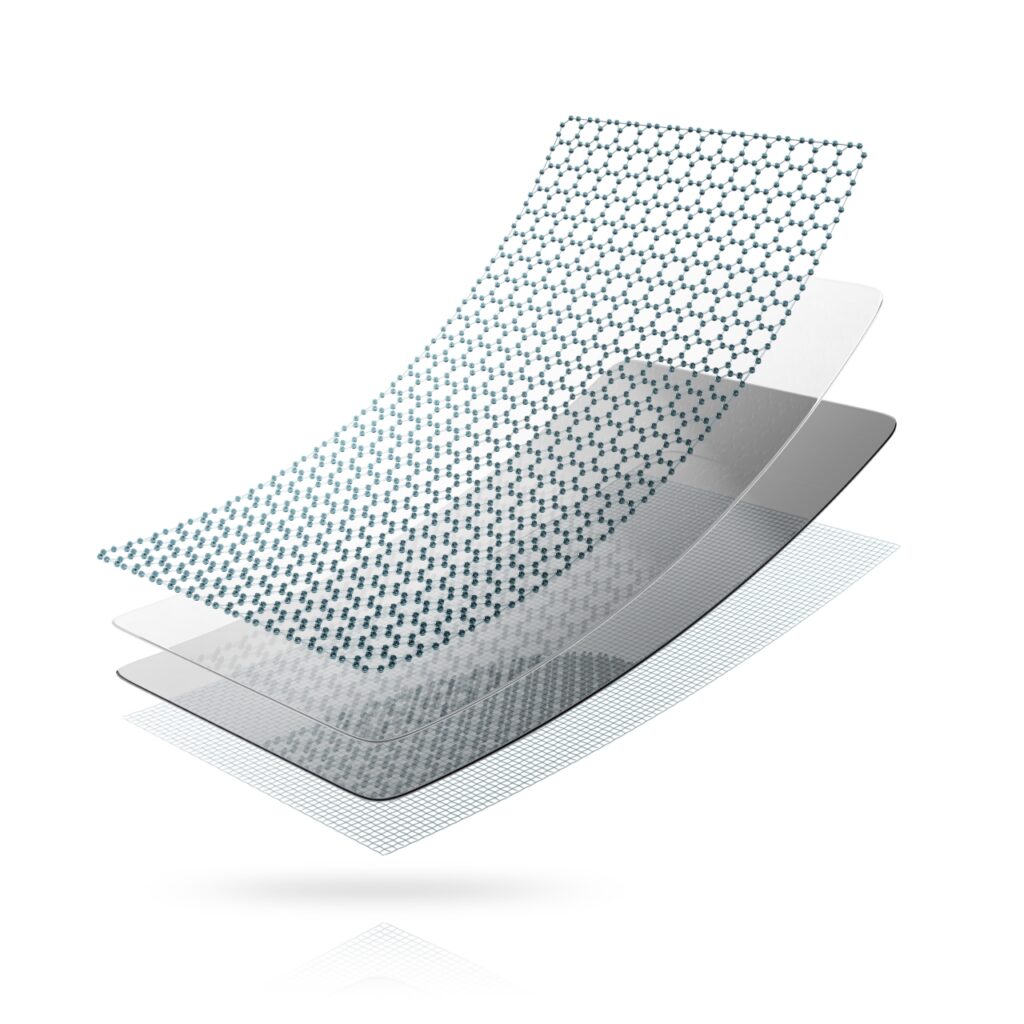
■ The More Functions Are Stacked, the More Complex the Component Becomes
A single thermal management component is also required to have functions other than heat dissipation.
For example, functions such as
・Not conducting electricity
・Fixing to the product
・Conforming to steps
・Absorbing vibration
・Suppressing electromagnetic noise
・Preventing the entry of moisture and dust
・Avoiding interference with surrounding components
It is difficult for a single material to satisfy all of these.
So multiple materials are laminated.
For example, an insulating film is layered onto graphite, which spreads heat in the in-plane direction.
Adhesive material for fixing is layered onto metal foil.
Foam for step absorption is combined with a thermally conductive sheet.
By combining materials this way, a single component can be given multiple functions.
On the other hand, the more types of materials there are, the more problems arise, such as
・More interfaces
・More differences in thermal expansion
・More differences in hardness
・More complex thickness management
・More causes of warping and peeling
Lamination is a technology that adds functions.
At the same time, it is also a technology that manages the differences in how materials move relative to each other.
■ Materials Expand and Contract When Temperature Changes
Many materials expand when temperature rises and contract when temperature falls.
A typical indicator of the size of this dimensional change in response to temperature change is the coefficient of linear expansion.
Conceptually, the change in length due to temperature is determined by
・The original length
・The temperature change
・The material’s coefficient of linear expansion
The longer the original length, the larger the dimensional change.
The larger the temperature difference, the larger the dimensional change as well.
And if the coefficients of linear expansion of materials differ, the amounts they stretch differ even when subjected to the same temperature change.
Metal foil and resin film.
Graphite and adhesive material.
Ceramic-based sheets and foams.
When these are laminated together, they do not each stretch by the same amount.
On their own, materials can stretch relatively freely.
When laminated, however, they constrain each other’s movement.
The material that is less likely to stretch holds back the material that tries to stretch more.
The material that is less likely to stretch is pulled by the material that tries to stretch.
As a result, stress arises inside the laminate.
■ Warping Is the Surfacing of Forces Between Materials
When a component made by laminating different materials warps, it is not necessarily due only to processing errors.
When materials stretch differently, it becomes hard for the laminate to hold its internal forces while remaining flat.
So the whole component bends to try to balance the internal forces.
For example, if the upper material tries to stretch more than the lower material, the laminate curves in one direction.
When the temperature falls, it may move in the opposite direction.
This is a phenomenon similar to a bimetal, which bends by using the difference in thermal expansion between two types of metal.
In thermal management components too, warping may occur with combinations such as
・Metal foil and resin film
・Graphite and insulating film
・Ceramic filler-based sheets and flexible materials
・Thick base materials and thin adhesive layers
When warping occurs, it leads to problems such as
・Component edges lifting
・Being unable to pick it up by suction on automated machines
・Application position shifting
・Compression bonding pressure becoming uneven
・Actual contact area decreasing
In other words, warping is not a cosmetic problem.
It is a problem that breaks both thermal contact and automated supply.
■ Asymmetric Laminated Structures Warp Easily
If the top and bottom of a laminate have similar structures, the forces generated by each material may cancel each other out.
In actual thermal management components, however, there are many asymmetric structures, such as
・Providing adhesive material on only one side
・Layering metal foil on only one side
・Partially laminating only where necessary
・Covering only the surface with insulating film
In asymmetric structures, the front and back of the component differ in
・Material configuration
・Thickness
・Hardness
・Thermal expansion
・Moisture absorption
That is why warping tends to occur when subjected to changes in temperature and humidity.
Components with release film require particular attention.
Even if it is flat with the release film attached, it may only be that the release film is constraining the component.
The moment it is peeled, internal stress is released and the component may curl up.
Therefore, checking flatness requires checking not only
whether it is flat on the release film,
but also whether it is in a state that automated machines can handle even after peeling.
■ In Partial Lamination, the Boundary of a Function Becomes the Boundary of Stress
Partial lamination, which places metal foil or heat dissipation material only where needed, is effective in reducing material usage and component thickness.
However, at the boundary between laminated and non-laminated parts,
・Thickness
・Bending stiffness
・Thermal expansion
・Stress
・The flow of heat
change abruptly.
When force concentrates at this boundary,
・Edges may lift
・Interlayer delamination may start
・Fold lines may remain in the film
・Steps may appear after temperature changes
For example, when metal foil is applied to only part of a thin insulating film, the ease of bending changes greatly at the edge of the metal foil.
During winding and peeling, bending stress concentrates at this boundary.
In other words, in partial lamination, not only placing the function where it is needed,
but also how to design the boundary where that function ends is important.
■ The Way a Component Moves Changes with the Combination of Thickness and Hardness
Warping and deformation of dissimilar materials are not determined by the coefficient of linear expansion alone.
Each layer’s
・Thickness
・Hardness
・Bending stiffness
・Flexibility of the adhesive layer
・Lamination order
also have an influence.
Thin films bend easily with even a small force.
Thick metal layers are hard to deform.
Soft adhesive materials easily absorb movement between materials.
Hard adhesive layers strongly constrain materials against each other.
For example, if a thick metal foil is applied to a thin resin film, the movement of the laminate tends to be dominated by the metal side.
Conversely, if very thin metal foil is combined with thick foam, the compression and deformation of the foam affect the shape of the entire component.
Therefore, in laminate design, it is necessary to consider not only “which materials to use,” but
at what thickness, in what order, and with what hardness the materials are stacked.
■ There Are Shapes That Are Unnecessary in the Finished Product but Necessary for the Process
To stabilize automation, shapes that do not remain in the finished product are sometimes provided temporarily.
For example,
・Suction tabs
・Margins for starting peeling
・Position recognition marks
・Connecting parts for transport
・Support frames
・Bridges for scrap removal, and so on.
Looking only at the finished product drawing, these seem wasteful.
However, having those shapes makes it possible to
・Suppress deformation during peeling
・Secure a suction surface
・Stabilize transport posture
・Make position recognition easier
・Protect narrow shapes
In other words, mass-produced components need both shapes that realize product functions and
shapes that make the process work.
■ Adhesive Material Is Both a Fixing Material and a Stress-Relief Layer
The role of adhesive material is not only to fix components to the product.
It also has the role of sitting between dissimilar materials and absorbing the differences in how each stretches.
With a flexible adhesive layer, even if metal and resin stretch by different amounts, stress can be relieved by deformation inside the adhesive layer.
However, if the adhesive material is too hard, it cannot absorb movement between materials.
If it is too thin, there is little margin to relieve stress through shear deformation.
On the other hand, if it is too soft,
・Components may shift at high temperatures
・Adhesive may squeeze out from the edges
・It may deform under continued load
・Positional accuracy may not be maintained
In other words, adhesive material is required to have multiple performance characteristics:
・Fixing
・Conforming to surface irregularities
・Absorbing differences in thermal expansion
・Maintaining thickness
・Holding position even at high temperatures
It is not a simple problem that can be solved by choosing a material with high adhesive strength.
■ Summary (Part 1)
By combining dissimilar materials, thermal management components gain many functions. However, the more materials are stacked, the more their “differences in how they move” also pile up.
The amount they stretch with temperature differs. The amount they swell with humidity differs. Their ease of bending differs. Their hardness differs.
Even if flat at the moment of lamination, they warp when temperature changes. Even if accurate during processing, interfaces shift little by little during use. Adhesive material is a fixing material and, at the same time, a buffer that absorbs these differences in movement.
However, there is much that a single adhesive material cannot solve. The problem lies not only in material selection, but in the design of the lamination order, thickness, and configuration itself.
So what happens, and where, after that component leaves the processing factory? It is wound onto a reel. Transported. Peeled. Picked up by suction. Applied.
In the next article (6-7-2), we will organize what happens to the component during those processes.
Column Supervisor: Koji Kakumoto (President, OTIS Co., Ltd.)
After studying abroad and working in planning and development at a trading company, he joined OTIS Co., Ltd. in 2011. While primarily working in the Corporate Planning Department, he has also served concurrently in manufacturing and technical divisions, and since 2018 has served as President, working to drive business growth and strengthen the organization.
This article is a general technical explanation intended for educational purposes and does not refer to any specific company, product, or technology.