
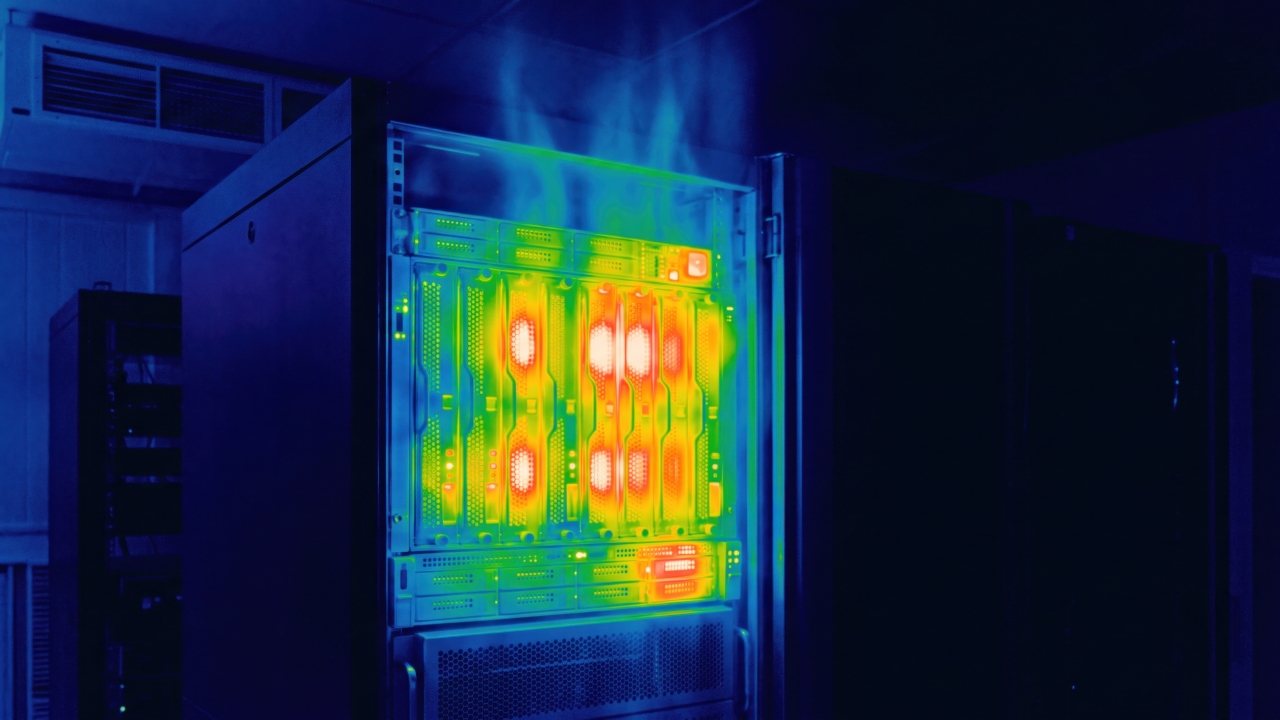
■ Conventional Cooling Control
In general cooling control, control is performed such as
Temperature rises
↓
Fan speed is raised
or
Temperature rises
↓
Coolant flow is increased
This is very rational.
Basically, however, it is control that responds after the temperature has changed.
When heat generation increases sharply, the temperature may rise temporarily before cooling catches up.
■ AI Control Predicts "What Is About to Get Hot"
In AI control, data such as
● Past temperature changes
● CPU/GPU load
● Power consumption
● Fan speed
● Coolant flow
● Outside air temperature
● Server operating status
are used.
From these, it predicts which place’s temperature is likely to rise next.
For example, when GPU load increases sharply,
before the temperature sensor detects high temperature,
fan speed is raised.
Coolant flow is increased.
Air-conditioning settings are changed.
Such control may become possible.
In other words, it changes from cooling after looking at the temperature to cooling before the temperature rises.
■ Reducing Overcooling
In conventional cooling systems, cooling is sometimes done more than necessary to be on the safe side.
For example, assuming the state of maximum heat generation,
always running at high fan speed.
Always maintaining a low cooling water temperature.
In reality, however, systems are not always running at maximum load.
If the load state can be grasped by AI, control such as
lowering cooling capacity at low load,
and raising cooling capacity before load becomes high
becomes possible.
This means the cooling power itself may be reduced.
■ AI Servers Do Not Always Generate the Same Amount of Heat
In AI servers, computing load changes depending on the processing content.
Training.
Inference.
Standby.
Communication.
The power consumption of GPUs and CPUs changes depending on the processing content.
In other words, heat generation is not constant either.
Cooling all servers at maximum capacity at all times wastes cooling power.
On the other hand, lowering cooling capacity too much causes temperatures to rise sharply at high load.
AI control becomes a method for linking computing load and cooling capacity.
■ Controlling the Entire Data Center, Not Just a Single Server
The target of AI-controlled cooling is not just a single server.
In data centers, many facilities are involved, such as
● Servers
● Racks
● Fans
● Air conditioning
● Cooling water
● Pumps
● Chillers
For example, only one rack has high load.
Another rack is barely used.
In this case, the entire building does not need to be cooled with the same intensity.
Concentrate cooling capacity in places with high load.
Weaken cooling in places with low load.
If such optimization can be done, the efficiency of the entire facility may be increased.
■ Temperature Sensors Alone Are Not Enough
AI control requires a lot of data.
Looking only at temperature does not tell you
why the temperature rose.
For example,
GPU load increased.
Fan performance declined.
Intake air temperature rose.
TIM contact deteriorated.
A filter became clogged.
All of these can lead to temperature rise.
So multiple pieces of information are combined, such as
● Temperature
● Power consumption
● Flow rate
● Pressure
● Fan speed
● Room temperature
● Computing load
AI can learn these relationships and estimate the causes of temperature changes and future states.
■ It Can Also Be Used for Anomaly Detection
AI-controlled cooling is not just an energy-saving technology.
It can also be used to find equipment abnormalities early.
For example,
the temperature is high even though GPU load is the same as before.
The same temperature cannot be maintained unless fan speed is higher than before.
Cold plate temperature is high even though coolant flow is the same.
If there are such changes, there may be
● TIM degradation
● Fan degradation
● Flow path clogging
● Decline in pump performance
● Fouling of heat exchangers
In other words, AI can also be used for condition monitoring of cooling equipment.
■ Predicting Hot Spots
In electronic devices, the entire product does not generate heat uniformly.
Only some semiconductors may become hot.
By using AI to analyze
● Computing processes
● Power supply load
● Past temperature distributions
it may be possible to predict where hot spots are likely to occur.
Based on this,
● Local fan control
● Coolant flow control
● Distribution of computing load
are carried out.
In other words, in AI control, not only cooling heat,
but also moving heat generation itself to places where it is less likely to occur can be considered.
■ Thermal Management by Moving Computing Load
For example, suppose the temperature of a certain GPU is rising.
Normally, that GPU would be cooled further.
As another method, however, the processing itself can be moved to another GPU.
Distributing load also distributes heat generation.
In other words, in thermal management in the AI era, rather than controlling only cooling equipment,
there is the possibility of controlling computing processes and cooling at the same time.
This is a very different way of thinking from conventional thermal management.
■ AI-Controlled Cooling Can Also Be Used in Robots
Robots have multiple heat sources, such as
● AI computing units
● Motors
● Batteries
● Motor drivers
Furthermore, the place of heat generation changes depending on the motion.
Walking.
Carrying heavy objects.
Standby.
High-speed motion.
If AI can predict the motion schedule, control such as
cooling before load becomes high,
and conversely suppressing cooling at low load
becomes possible.
In battery-powered robots, reducing cooling power also leads to longer operating time.
■ It Can Also Be Applied to EVs and ESS
In EVs and ESS, keeping cell temperatures within a certain range is important.
Charging.
Fast charging.
Discharging.
Outside air temperature.
Cell degradation state.
These change the heat generation state.
By predicting future temperatures with AI and controlling
● Coolant flow
● Pump output
● Fans
● Charge/discharge conditions
efficient temperature management may become possible.
■ AI Control Also Has Weaknesses
Using AI does not necessarily make optimal cooling possible.
AI control has challenges such as
● Sensor accuracy
● Training data
● Model reliability
● Control delay
● Safety design for abnormal situations
For example, if a temperature sensor outputs incorrect values, AI may also make incorrect judgments.
Also, in abnormal states it has not learned, it may not be able to control appropriately.
That is why, rather than leaving safety control to AI alone,
it must be combined with conventional safety control.
■ AI Control Cannot Exceed Physical Cooling Capacity
AI can make cooling more efficient.
However,
it cannot exceed the physical capacity of the cooling equipment itself.
The heat sink is too small.
Coolant flow is insufficient.
The TIM is lifting.
The fan is broken.
In such states, no matter how excellent the AI is, it cannot cool.
In other words, AI control is not a technology that replaces good thermal design.
It is a technology that uses good thermal design more efficiently.
■ Sensor Position Also Becomes Important
In AI control, the quality of input data is important.
For example, if a temperature sensor is far from the heat source, it changes with a delay relative to the actual chip temperature.
Local hot spots may also not be detected.
That is why
● Sensor position
● Number of sensors
● Measurement speed
● Measurement accuracy
also become important.
In other words, AI-controlled cooling needs not only AI models, but a structure that can acquire correct thermal data.
■ The Researcher's Perspective: AI Predicts "the Future of Heat"
Conventional control acts by looking at
the current temperature.
In AI control, from
● Current temperature
● Past temperature changes
● Current load
● Future computing schedules
● Surrounding environment
it is possible to predict the temperature several seconds or several minutes later.
In other words, thermal control is moving from controlling the present
to predicting and controlling the future.
■ The Shop-Floor Perspective: Before Introducing AI, Make Temperature Data Trustworthy
Temperature data is inaccurate.
Sensor positions are poor.
Equipment status is not recorded.
Introducing AI in such a state makes good control difficult.
What is needed first is to collect
● Correct sensors
● Stable measurement
● Equipment data
● Operating history
AI-controlled cooling
does not start with an AI model.
It starts with good data.
■ OTIS's Perspective
AI-controlled cooling itself is not OTIS’s area of expertise.
OTIS is not a company that develops
● AI control software
● Data center cooling algorithms
● Temperature prediction models
However, no matter how advanced AI control becomes,
what actually moves heat is physical components.
TIM.
Heat dissipation sheets.
Insulating materials.
Graphite.
Cold plates.
If these are not in correct contact, heat will not move sufficiently even if AI raises cooling capacity.
In other words, OTIS’s role lies in
processing components so that the cooling directed by AI control actually works inside real products.
■ What OTIS Can Do
At OTIS, through
● TIM processing
● Heat dissipation sheet processing
● Graphite processing
● Insulating film processing
● Adhesive processing
● Metal foil processing
● High-precision lamination
● Fine die-cutting
● Reel supply
● Component processing for automated application
we can support the physical heat paths of AI-controlled cooling systems.
■ Outside OTIS's Expertise
OTIS is not a company that specializes in
● AI cooling algorithm development
● Temperature prediction AI development
● Data center control systems
● Control design of entire cooling facilities
● Development of sensors themselves
■ Industries Where This Technology Will Be Important
★★★★★ AI servers and data centers
★★★★★ High-performance computing
★★★★☆ EVs and next-generation batteries
★★★★☆ ESS
★★★★☆ Robots and automation equipment
★★★★☆ Communication equipment
★★★★☆ Industrial equipment
■ Summary
AI-controlled cooling is not a technology for increasing cooling capacity, but a technology for using cooling capacity wisely
In conventional cooling, control centered on
the temperature rose.
So cool it.
In AI control,
load,
temperature,
outside air,
past states,
and equipment states
are combined to predict where will get hot from now on.
Then
● Fans
● Pumps
● Coolant
● Air conditioning
● Computing load
are adjusted.
This may make it possible to cool the necessary places, at the necessary timing, only as much as necessary.
However, AI cannot make heat disappear.
If the TIM is lifting, heat does not flow.
If the capacity of the cooling equipment is insufficient, even AI cannot cool.
In other words,
AI control is not a technology that replaces thermal design.
It is a technology that uses good thermal design more wisely.
Column Supervisor: Koji Kakumoto (President, OTIS Co., Ltd.)
After studying abroad and working in planning and development at a trading company, he joined OTIS Co., Ltd. in 2011. While primarily working in the Corporate Planning Department, he has also served concurrently in manufacturing and technical divisions, and since 2018 has served as President, working to drive business growth and strengthen the organization.
This article is a general technical explanation intended for educational purposes and does not refer to any specific company, product, or technology.



