■ Thermal Conductivity Is the Performance of "the Material Itself"
Thermal conductivity is a material property that indicates how easily the material conducts heat.
It is an extremely important number for comparing materials and is by no means meaningless.
The problem is judging actual thermal performance from that number alone.
In actual products, heat does not flow only within the material itself.
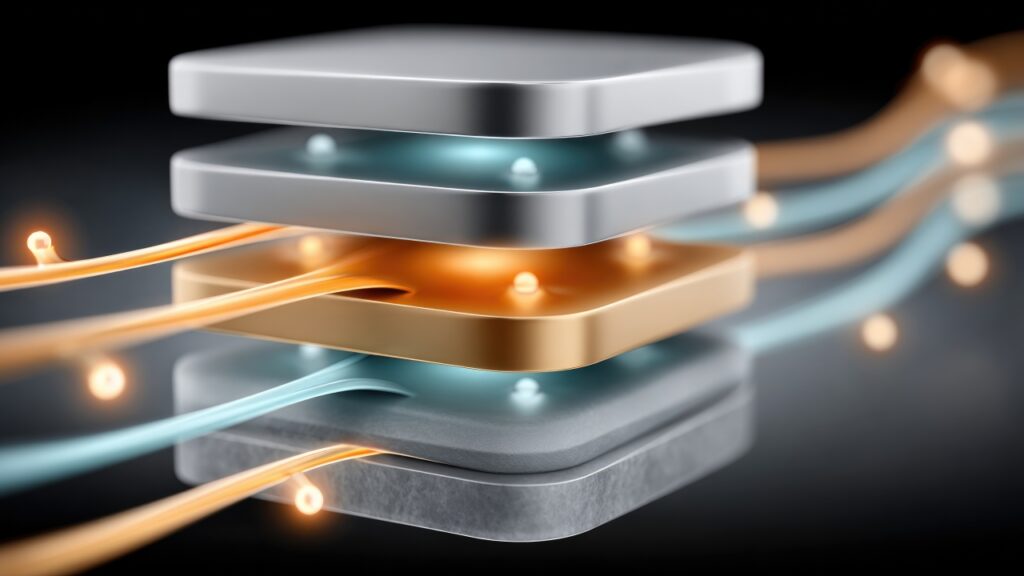
For example, with a structure of
Heat-generating component
↓
TIM
↓
Heat sink
heat passes at least through the interface between the heat-generating component and the TIM, the inside of the TIM, and the interface between the TIM and the heat sink.
In other words, the actual heat path contains elements other than the material itself.
■ What Matters Is Not Only "Thermal Conductivity" but "Thermal Resistance"
Even if a material’s thermal conductivity is high, heat passes through it less easily if it is thick.
Conversely, even if thermal conductivity is not very high, thermal resistance can sometimes be kept small if the material is very thin.
Simplified, the thermal resistance of a material can be thought of as
thickness ÷ thermal conductivity
For example, even if a material with high thermal conductivity is adopted, using a thick material to absorb steps loses some of that advantage.
Conversely, even a material with relatively low thermal conductivity can give excellent results in the actual device if it is very thin and adheres well.
Therefore, when comparing materials, it is necessary to look not only at “How many W/m·K?”
but also at “At what thickness in mm will it actually be used?”
■ Even More Important Is "Contact Thermal Resistance"
When actual surfaces are magnified, they are not perfectly flat.
Semiconductor packages, metal enclosures, heat sinks, cooling plates.
These have fine irregularities.
Even when two components are stacked, the entire surface is not in perfect contact.
If air remains in those gaps, heat flows less easily.
That is why TIM has the important role not only of conducting heat, but of
filling the fine irregularities of surfaces and increasing the actual contact area.
Even if a material’s thermal conductivity is very high, if it is too hard to conform to the surface, gaps remain at the interface.
As a result, it may not perform as well as its catalog specifications.
This “interface” problem is covered in more detail in the next column, 9-2.
■ Softer Is Not Always Better Either
Then, should a soft TIM be used?
This is not simple either.
Soft materials have the advantages that
● They conform easily to irregularities
● They absorb steps easily
● They make it easy to secure contact area
On the other hand, problems may occur such as
● Shape changes due to compression
● Squeezing out
● Thickness changing under long-term load
● Being hard to handle during assembly
In other words, TIM is required to have not only thermal performance, but also
hardness, compressibility, recovery and shape stability.
■ "The Higher the Performance, the Better" Is Not Always True
High thermal conductivity TIM sometimes contains a large amount of filler to increase thermal conductivity.
Increasing the amount of filler may raise thermal conductivity.
On the other hand, the material may also become harder.
Then, even if performance on the catalog improves greatly from 3 W/m·K to 8 W/m·K,
in practice the 8 W/m·K material may be harder and conform less well to the object.
In that case, although the performance inside the material is high, heat is stopped at the interface.
That is why, in material selection, rather than “the material with the highest thermal conductivity,”
one must choose “the material that can minimize thermal resistance in the actual structure.”
■ Performance Also Changes with Pressure
The contact state of TIM changes depending on how much pressure it is sandwiched under.
As pressure increases, the TIM is compressed, the contact area increases and gaps decrease, which can lower thermal resistance.
In actual products, however, pressure cannot be raised without limit.
Boards warp.
Stress is applied to components.
Enclosures deform.
That is why it is necessary to check whether performance is achieved within the range of pressure that can be applied in the actual product.
If the conditions of catalog measurement and actual assembly conditions differ, the results will differ even with the same material.
■ Flatness and Warping Also Change Material Performance
For example, suppose a 100 mm square cooling plate is not perfectly flat,
and has slight warping in the center.
Even with TIM sandwiched in between,
the center may be in strong contact
and the periphery in weak contact.
Then the TIM thickness and contact pressure vary by location.
Even if excellent performance is achieved with uniform test pieces in a material manufacturer’s catalog,
the same state is not necessarily achieved in the actual product.
Here too, look at the mounted state before material performance.
■ Adding an Adhesive Layer Also Changes Thermal Performance
In actual volume production, an adhesive layer is sometimes added to fix the TIM.
Even if the material alone has high thermal performance,
if the structure becomes
TIM
+
Adhesive layer
+
Protective film
heat passes through all of them.
Especially in thin products, even an adhesive layer of a few tens of μm may not be negligible.
In other words, it is necessary to look not only at “how many W/m·K the TIM itself is,” but at
thermal performance across the entire final laminated structure.
■ Adding an Insulating Film Changes the Conditions Further
In power semiconductors and the like, insulation is needed at the same time as heat dissipation.
That is why the structure may be
Heat-generating component
↓
TIM
↓
Insulating film
↓
Cooling plate
In this case, the insulating film also becomes part of the heat path.
Considering only thermal performance, you want it thinner.
But considering insulation performance, a certain thickness is needed.
In other words, in actual products, materials cannot be chosen on heat alone.
Insulation, withstand voltage, strength, processability, reliability. A balance with these is needed.
■ Also Check the Directionality of the Material
Depending on the material, there is directionality in how heat is transferred.
A typical example is graphite.
Graphite sheets are generally used as materials that spread heat very well in the in-plane direction.
However, the required material characteristics differ depending on whether you want to spread heat in the in-plane direction
or release heat in the thickness direction.
For example, for an application of “carrying the heat of an IC to a distant part of the enclosure,”
in-plane heat-spreading performance is important.
On the other hand, for an application of “transferring heat to a heat sink directly above the IC,”
thermal resistance in the thickness direction is important.
It cannot be judged from the single number “high thermal conductivity.”
■ If Test Methods Differ, the Numbers Sometimes Cannot Be Compared Simply
Looking at material manufacturers’ catalogs, even for the same item “thermal conductivity,”
measurement methods and test conditions may differ.
That is why it sometimes cannot simply be said that
Company A: 5 W/m·K.
Company B: 7 W/m·K.
Therefore Company B is always superior.
When comparing, it is desirable to also check
● Measurement method
● Test temperature
● Sample thickness
● Pressure conditions
This is especially important when comparing materials from different manufacturers.
■ Judging by Initial Performance Alone Leads to Failure
It cooled well right after prototyping.
But six months later, performance dropped.
Such things also need to be considered.
TIM and adhesives may change in condition due to
● High temperatures
● Temperature cycling
● Humidity
● Vibration
● Long-term compression
They harden. They soften. They shift. They peel. They pump out.
Then the contact state changes, and thermal performance also changes.
Therefore, it is necessary to look not only at initial thermal performance, but at thermal performance throughout the period of use.
■ Processing Adds Conditions Not Found in Catalogs
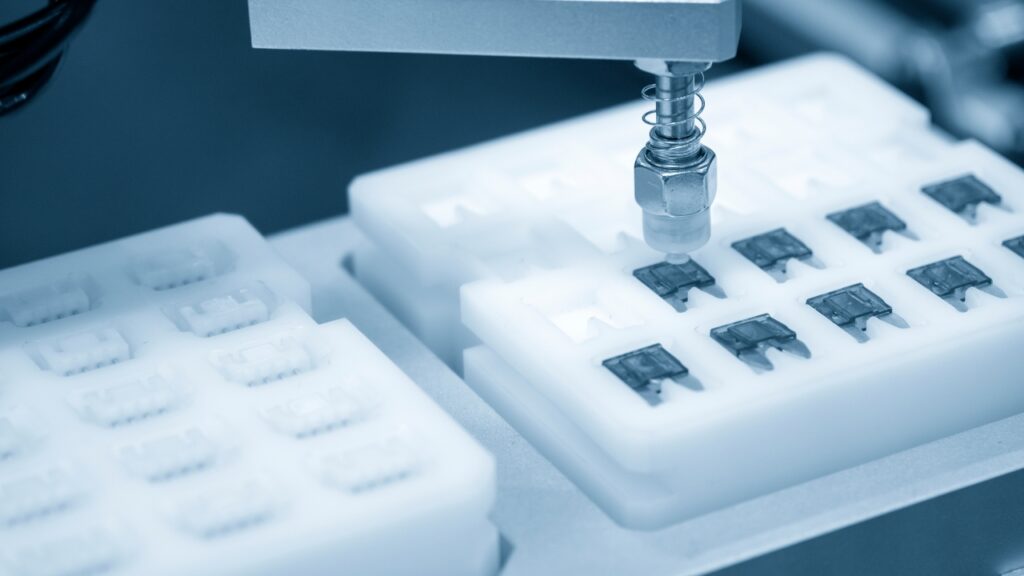
Sheets purchased from material manufacturers do not necessarily go into products as they are.
In practice, they are die-cut, cut, perforated, have adhesives applied, are laminated with insulating materials, and are made into reels.
Then new conditions are added, such as
● Dimensional tolerances
● Burrs
● Deformation
● Compression
● Foreign matter
● Lamination misalignment
In other words, what customers actually use is not the “material” listed in a material manufacturer’s catalog, but the processed “component.”
■ The Question "Which Is Better, Material A or Material B?" Alone Is Not Enough
In thermal management consultations, the question “Which material is better, A or B?” comes up.
But there are things one would really like to confirm before that.
● What do you want to cool?
● How much heat is generated?
● Where will heat be released?
● How large is the contact area?
● How much thickness is acceptable?
● How much pressure can be applied?
● Is insulation needed?
● Is waterproofing needed?
● How will it be applied in volume production?
● What is the operating temperature?
The optimal material changes depending on these.
Therefore, in thermal management, it is important to define “in what state it will be used” before material selection.
■ Failure Example: Doubling Only the Thermal Conductivity
For example, a 3 W/m·K TIM is currently used.
Because the component temperature is high, it is changed to 6 W/m·K.
Looking only at the numbers, thermal conduction performance appears to have doubled.
However, the new material is hard and does not conform sufficiently to the surface.
Furthermore, the required thickness increases, and contact thermal resistance also increases.
As a result, the temperature in the actual device barely changes.
Only the material cost goes up.
This is a failure that can easily happen.
The problem is not the number 6 W/m·K.
It is whether the resistance of the entire heat path has truly decreased in the state where that material is used.
■ Failure Example: A High-Performance Material Was Chosen, but It Cannot Be Mass-Produced
In prototyping, a high-performance TIM was applied by hand.
Thermal performance was also good.
So adoption for volume production is decided.
However, when put into volume production equipment, it is too soft to peel. It deforms when picked up. Its position is unstable. The material stretches.
As a result, it cannot be applied automatically.
There are cases where a material that is correct in terms of thermal performance is not correct as a volume-produced component.
This problem is covered in detail in 9-3 and 9-4.
■ The Researcher's Perspective: Evaluate the "Entire Heat Path," Not the Material
When considering heat problems, it is not enough to take out a single material and evaluate it.
Where does heat pass from the heat source to the final heat dissipation destination? What is along the way?
Look at where the greatest resistance lies.
For example, with a structure of
Chip
↓
TIM
↓
Insulating layer
↓
Metal plate
↓
Cooling water
all of these determine thermal performance.
Even if only the TIM is made higher-performance, the effect is limited if the bottleneck is somewhere else.
■ The Shop-Floor Perspective: Look at the Actual Item Before Changing Materials
When a request comes in to “switch to a higher-performance TIM,”
before immediately looking for materials, peel off the current TIM.
Look at the compression marks.
Look at the air bubbles.
Look at the contact surfaces.
Look at misalignment.
Look at warping.
Such checks may reveal that the cause was not the material itself, but
how it was applied and the contact state.
Changing materials is an important option.
But checking the current heat path before changing materials is just as important.
■ OTIS's Perspective: The Roles of Material Manufacturers and Processing Manufacturers Are Different
Material manufacturers develop the materials themselves: higher thermal conductivity, higher insulation, softer TIM, thinner graphite.
This is extremely important.
On the other hand, the role OTIS should play is a little different.
Processing those materials into the required shapes.
Making them usable at the required thicknesses.
Laminating them with the required materials.
Making them ready to apply in the required positions.
And turning them into supply formats that can be handled stably in volume production processes.
Turning material performance into actual component performance.
This is the role of a processing company.
■ The Significance of OTIS Being Involved from the Material Selection Stage
After a drawing is completed,
OTIS can receive a request such as “Please die-cut this material into this shape.”
In thermal management, however, there is value in a processing company being involved much earlier.
For example,
this material is too thin to apply automatically.
With this shape, fine details tear easily.
With this adhesive configuration, it is hard to peel.
With this lamination, the thickness tolerance becomes large.
If such volume production problems can be checked at the design stage, rework after prototyping can be reduced.
In other words, it is important not to consider material selection and processing design separately.
■ What OTIS Can Do
At OTIS, through
● TIM processing
● Graphite processing
● Insulating film processing
● Copper foil and aluminum foil processing
● Adhesive processing
● High-precision die-cutting
● Thin-film processing
● Microfabrication
● High-precision lamination
● Lamination of dissimilar materials
● Partial lamination
● Half-cutting
● Reel-to-reel processing
● Supply formats for automated application
we can process thermal management materials into components that can be used in actual volume production processes.
Not developing the materials themselves, but
bringing them into a state that can be incorporated into actual products while losing as little of the material’s performance as possible.
That is OTIS’s role.
■ Outside OTIS's Expertise
OTIS is not a company that specializes in
● Development of TIM materials themselves
● Development of graphite materials themselves
● Semiconductor chip design
● Design of entire cooling equipment
● Dedicated CFD analysis
As needed, we work with material manufacturers, cooling equipment manufacturers, analysis companies and customers’ design departments.
What matters is not deciding “which material is the best in the world.”
It is considering “in this product, this structure and this process, which material, used in what state, will make it work.”
■ Summary: Thermal Management Does Not End with Comparing Material Catalogs
Thermal conductivity is important.
But it alone cannot select thermal management materials.
Thickness, hardness, compressibility, contact state, surface roughness, pressure, insulation, adhesive layers, laminated structure, aging, and the volume production process.
These combine to determine actual thermal performance.
That is why it cannot simply be said that “5 W/m·K is better than 3 W/m·K.”
What matters is not the peak performance of a material alone.
It is functioning most stably as an entire heat path when incorporated into the actual product.
A thermal management material is not yet complete at the point it is chosen.
Cutting. Laminating. Applying. Compressing. Fixing. And mass-producing.
Only after going through all of this does it become a thermal management component.
Many of the “thermal management failures” covered in Chapter 9
begin with overlooking this difference between material performance and mounted performance.
Column Supervisor: Koji Kakumoto (President, OTIS Co., Ltd.)
After studying abroad and working in planning and development at a trading company, he joined OTIS Co., Ltd. in 2011. While primarily working in the Corporate Planning Department, he has also served concurrently in manufacturing and technical divisions, and since 2018 has served as President, working to drive business growth and strengthen the organization.
This article is a general technical explanation intended for educational purposes and does not refer to any specific company, product, or technology.