■ What Is Miniaturization?
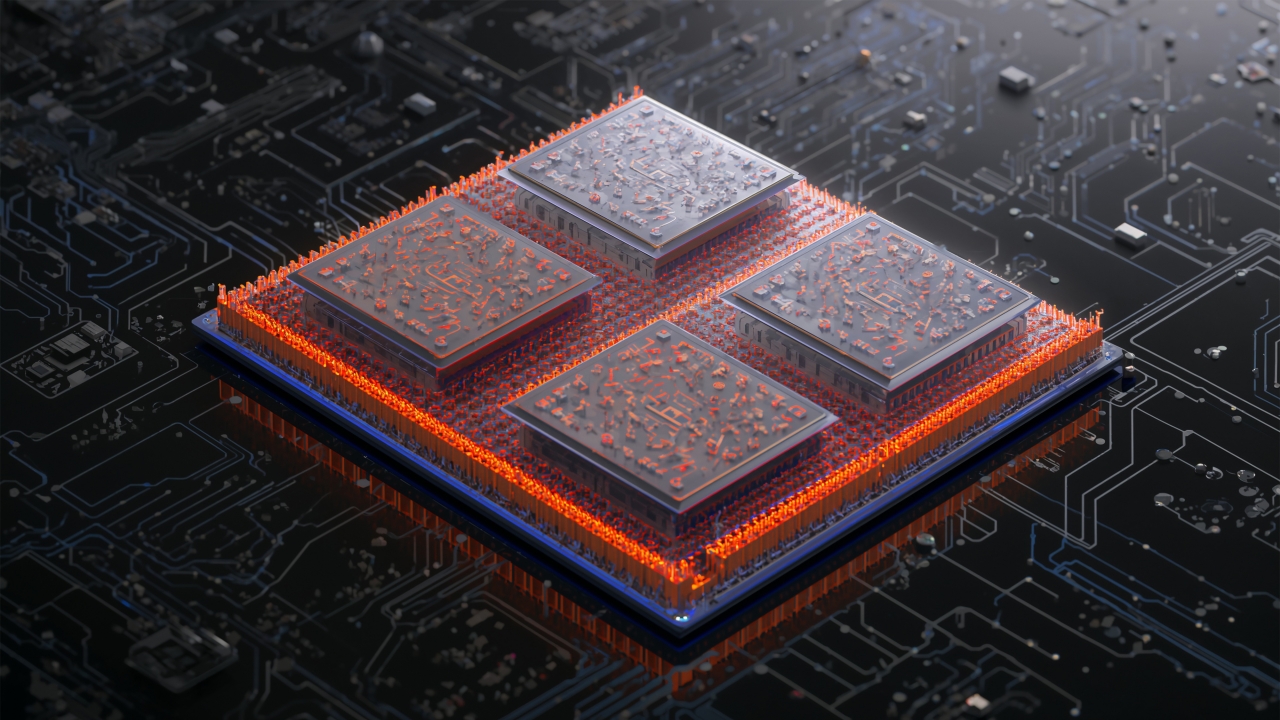
Miniaturization means making components, circuits, wiring, processed shapes, and so on smaller.
For example,
● Miniaturization of semiconductor circuits
● Downsizing of electronic components
● Reduction of wiring pitch
● Adoption of thin-film components
● Fine die-cut shapes
● Reduction of gaps between components
● High-density mounting, and so on.
Miniaturization makes it possible to fit more functions into the same area.
At the same time, however, heat sources also become densely packed.
The smaller things get, the higher the heat density
When thinking about heat problems, the amount of heat generated alone is not enough.
What matters is heat density.
Heat density is the idea of how much heat is generated within a limited area or volume.
For example, even with the same 10 W of heat generation,
the difficulty differs between heat generated from an entire large metal plate
and heat generated from a small semiconductor chip.
The smaller the heat-generating area, the more easily local temperatures rise.
In other words, with miniaturization,
even if the amount of heat generated is the same, heat problems get worse.
■ The Area for Releasing Heat Decreases
As products and components become smaller, the surface area and contact area for releasing heat to the outside are also limited.
In large equipment,
● Large heat sinks
● Fans
● Cooling plates
● Wide metal enclosures
can be used.
In small products, however, there is no space to put these in.
In other words, with miniaturization, the contradiction arises that heat sources increase,
while the places to put cooling components decrease.
■ Heat-Generating Components Come Closer Together
In high-density mounting, the distance between heat-generating components becomes shorter.
Memory is near the GPU.
Communication components are near power supply components.
Sensors are near motors.
Control boards are near batteries.
Then the heat from one component affects the surrounding components.
In other words, with miniaturization, it is not enough to cool just one heat source;
the influence of heat sources on each other must also be considered.
■ Hot Spots Occur More Easily
With miniaturization, heat concentrates in a narrow range.
As a result, only some parts can become extremely hot.
This is a hot spot.
Even if the average temperature is not a problem, local high temperatures may lead to
● Reduced performance
● Degradation
● Malfunction
● Insulation defects
● Adhesive degradation
● Shorter lifespan
In other words, with miniaturization, local temperature matters more
than average temperature.
■ Misalignment of Tens of μm Has a Large Impact
When components are large, an application misalignment of 0.1 mm may be a small error.
However, when the components themselves are in the world of 1 mm or 2 mm, a 0.1 mm misalignment is large.
For example, if a 1 mm wide heat dissipation component shifts by 0.1 mm, that is a 10% positional misalignment.
In other words, with miniaturization, the same error has a larger relative impact.
As a result,
● Insufficient contact area
● Coming off the heat source
● Insufficient insulation distance
● Waterproof line defects
● Exposure of conductive materials
become more likely.
■ Slight Lifting Becomes Large Thermal Resistance
In fine components, the gaps between components are also small.
However, when air gets into those small gaps, heat has difficulty flowing.
For example, 0.1 mm of lifting may look small in a large structure.
In thin films and fine components, however, it can become a gap as large as or larger than the material thickness.
In other words, with miniaturization, slight lifting
becomes a large air layer that cuts off the heat path.
■ The Effect of Surface Roughness Becomes Larger
When components are large and thick, the effect of fine surface roughness can be relatively small.
In thin films and fine components, however, surface irregularities can no longer be ignored relative to the material thickness.
As a result,
● Contact area decreases
● Air layers increase
● Pressure becomes uneven
● Parts lift locally
In other words, with miniaturization, surface condition also becomes an important design item that determines thermal performance.
■ The Effects of Burrs and Foreign Matter Also Become Larger
In microfabrication, even small burrs and foreign matter become major problems.
If components are large, burrs of tens of μm may be small.
In fine components, however, such burrs may
● Lift the component
● Break through insulating layers
● Create electrical continuity
● Shift the application position
● Make contact pressure uneven
In other words, with miniaturization, small processing defects become major functional defects.
■ Thinner Lowers Thermal Resistance, but Makes Processing More Difficult
Thermal management materials generally make it easier to lower thermal resistance in the thickness direction when they are thinner.
That is why, with miniaturization and thinning, you want to make materials thinner.
However, making them thinner causes problems such as
● Wrinkling
● Stretching
● Tearing
● Warping
● Sticking due to static electricity
● Being hard to transport on automated machines
In other words, there is a contradiction: thinner is advantageous for heat,
but the thinner it is, the harder volume production becomes.
■ Miniaturization Also Makes Pressure Control More Difficult
TIM and heat dissipation sheets must be brought into contact with appropriate pressure.
In fine components, however, the contact area is small.
Even when the same force is applied, local pressure tends to become high.
If the pressure is too high,
● Components may crack
● Gel may squeeze out
● Adhesive material may flow
● Thin films may deform
Conversely, if pressure is insufficient, air layers remain.
In other words, with miniaturization, controlling the force that brings things into contact also becomes difficult.
■ Differences in Thermal Expansion Break Fine Structures
Materials expand and contract with temperature.
Metals, resins, ceramics, adhesive materials, and films have different coefficients of thermal expansion.
In fine structures, materials are strongly constrained within a narrow range.
That is why even slight differences in expansion can cause
● Warping
● Peeling
● Cracks
● Positional misalignment
● Changes in contact pressure
In other words, with miniaturization, not only the temperature rise itself,
but also structural deformation due to temperature changes is important.
■ In 3D Semiconductors, Places for Heat to Escape Decrease
In 3D semiconductors, chips and memory are stacked vertically.
This shortens wiring distances and enables higher performance.
In thermal management, however, it becomes more difficult.
This is because heat sources are stacked above and below each other.
Heat from the lower layers must escape to the outside through the upper layers and the substrate.
In other words, in 3D semiconductors,
miniaturization
high density
stacking advance at the same time, and the escape routes for heat become complex.
■ In AI Servers, Miniaturization and Higher Heat Generation Advance Together
In AI semiconductors, more computing circuits are integrated into smaller areas.
Furthermore, GPUs, HBM, and power supply components are placed close together.
As a result,
● Rising heat density
● Hot spots
● More interfaces
● Increased contact thermal resistance
● More difficult local cooling
occur.
In other words, in AI servers, the evolution of semiconductors itself is also
a factor that makes heat problems more difficult.
■ In Wearable Devices, the Distance to the Human Body Becomes Shorter
In wearable devices, miniaturization and thinning are strongly required.
However, because they are close to the human body, the surface temperature cannot be allowed to rise.
Furthermore, inside them are
● AI chips
● Batteries
● Communication components
● Sensors
In other words, in wearable devices,
miniaturization
higher functionality
proximity to the human body occur at the same time.
That is why heat spreading design that suppresses local temperature rises is important.
■ In Medical Devices, Even Slight Temperature Differences Are a Problem
In medical devices and biosensors, high safety and measurement accuracy are required in addition to miniaturization.
Even slight heat generation may
● Shift measured values
● Burden the skin
● Change sensor characteristics
● Increase the risk of low-temperature burns
In other words, in medical devices, even small heat problems cannot be ignored.
■ In Robots, the Inside of Joints Becomes Denser
Robot joints gather
● Motors
● Reduction gears
● Sensors
● Wiring
● Control boards
When trying to make joints thin and small like a human’s, the inside becomes even denser.
However, because joints move, it is difficult to place large cooling components.
In other words, in robots,
miniaturization
higher output
mobility must be achieved at the same time, making heat problems more difficult.
■ In Miniaturization, Material Directionality Is Also Important
In fine components, the direction in which heat is released is important.
For example, graphite easily spreads heat in the in-plane direction.
However, in the thickness direction, it may not conduct heat as well as in the in-plane direction.
In fine structures, the directions in which components can be placed are also limited.
That is why, not only material performance, but also
material orientation
processing direction
lamination direction determine thermal performance.
■ In Miniaturization, It Is Hard to Solve Problems with a Single Material
In fine thermal management, it is difficult to meet the requirements with a single material alone.
For example, it is necessary to combine
● Graphite to spread heat
● Insulating films to stop electricity
● Adhesive materials to fix
● EMI materials to suppress noise
● Waterproofing materials to stop water
However, as the number of layers increases, challenges also arise, such as
● Increased thickness
● Increased thermal resistance
● More lamination misalignment
● More processes
● Higher costs
In other words, with miniaturization, wanting to make it multifunctional and
wanting to make it thin collide.
■ The Researcher's Perspective: With Miniaturization, Heat Becomes a "Local" Rather Than an "Average" Problem
In large structures, it can be enough to look at the overall average temperature.
In fine structures, however, the local temperature distribution is important.
Temperatures differ just tens of μm apart.
Only some interfaces have high thermal resistance.
Only some components generate a lot of heat.
That is why, with miniaturization, the way of thinking must change from average thermal design
to local thermal design.
■ The Shop-Floor Perspective: With Miniaturization, Processing Errors Become Performance Errors
On the volume production floor, dimensions, position, thickness, burrs, and so on are controlled within tolerances.
With miniaturization, however, the tolerances themselves directly affect performance.
For example,
● Application misalignment of tens of μm
● Burrs of a few μm
● Slight thickness differences
● Minute foreign matter
● Small edge lifting
change thermal performance, insulation, waterproofing, and noise performance.
In other words, with miniaturization, processing errors become functional errors.
■ What to Check with Miniaturization
When designing and processing fine thermal management components, the following must be checked.
● What level of heat generation density there is
● Where the hot spots are
● In which direction heat is to be released
● Whether the contact area is sufficient
● Whether minute air layers remain
● What the allowable range of application misalignment is
● What the allowable values for burrs and foreign matter are
● How thickness variation affects thermal resistance
● Whether position and contact change due to differences in thermal expansion
● Whether it can be handled stably in automated processes
In other words, with miniaturization, materials, structure, processing, and process cannot be considered separately.
■ OTIS's Perspective
The intersection of miniaturization and heat problems is an area where OTIS is highly likely to be able to deliver value.
OTIS is neither a company that designs semiconductor chips themselves nor a company that develops thermal materials themselves.
However, in areas such as
● Processing into fine shapes
● Handling thin materials
● Laminating dissimilar materials with high precision
● Creating the intended positional relationships
● Suppressing burrs and foreign matter
● Supplying to automated processes
● Suppressing variation in volume production
we may be able to contribute.
The further miniaturization advances, the less problems can be solved by material specifications alone.
What shape to make the material into, where to place it, and in what state to mass-produce it becomes important.
■ What OTIS Can Do
At OTIS, through
● Fine die-cutting
● Thin-film material processing
● Graphite sheet processing
● Metal foil processing
● Insulating film processing
● Adhesive material processing
● EMI material processing
● High-precision lamination
● Lamination of dissimilar materials
● Evaluating the processing of narrow-pitch shapes
● Reel supply
● Designing supply formats for automated processes
and more, we may be able to contribute to bringing miniaturized thermal management components closer to a state in which they can be used in volume production.
■ Outside OTIS's Expertise
On the other hand, OTIS is not a company that specializes in
● Semiconductor circuit miniaturization technology
● Semiconductor front-end processes
● GPU and AI chip design
● Dedicated CFD analysis
● Design of entire cooling equipment
● Formulation development of thermal materials themselves
However, in the area of making thermal management components that have become more difficult due to miniaturization work in volume production through processing and lamination,
we may be able to play an important role.
■ Industries Where This Technology Will Be Important
★★★★★ AI semiconductors and 3D semiconductors
★★★★★ AI servers
★★★★★ Smartphones
★★★★★ Wearable devices
★★★★☆ Medical devices
★★★★☆ Robots
★★★★☆ EVs and electrical components
■ Summary
With miniaturization, heat problems do not become smaller; they become more difficult
When products and components become smaller, heat problems may also seem to become smaller.
In reality, however, it is the opposite.
With miniaturization,
● Heat density rises
● Heat sources come closer together
● The area for releasing heat decreases
● Hot spots occur
● The effects of minute lifting and air layers become larger
● Misalignment of tens of μm changes performance
● Burrs and foreign matter break functions
● Differences in thermal expansion affect structures
In other words, miniaturization does not mean becoming a small world.
It means becoming a world where small errors are not tolerated.
In future thermal management, choosing high-performance materials is not enough.
Materials must be processed thinly, finely, and accurately, incorporated in the intended positions, and the same state must be reproduced even in volume production.
The further miniaturization advances, the more the last few tens of μm of thermal management will determine the performance of the entire product.
Column Supervisor: Koji Kakumoto (President, OTIS Co., Ltd.)
After studying abroad and working in planning and development at a trading company, he joined OTIS Co., Ltd. in 2011. While primarily working in the Corporate Planning Department, he has also served concurrently in manufacturing and technical divisions, and since 2018 has served as President, working to drive business growth and strengthen the organization.
This article is a general technical explanation intended for educational purposes and does not refer to any specific company, product, or technology.