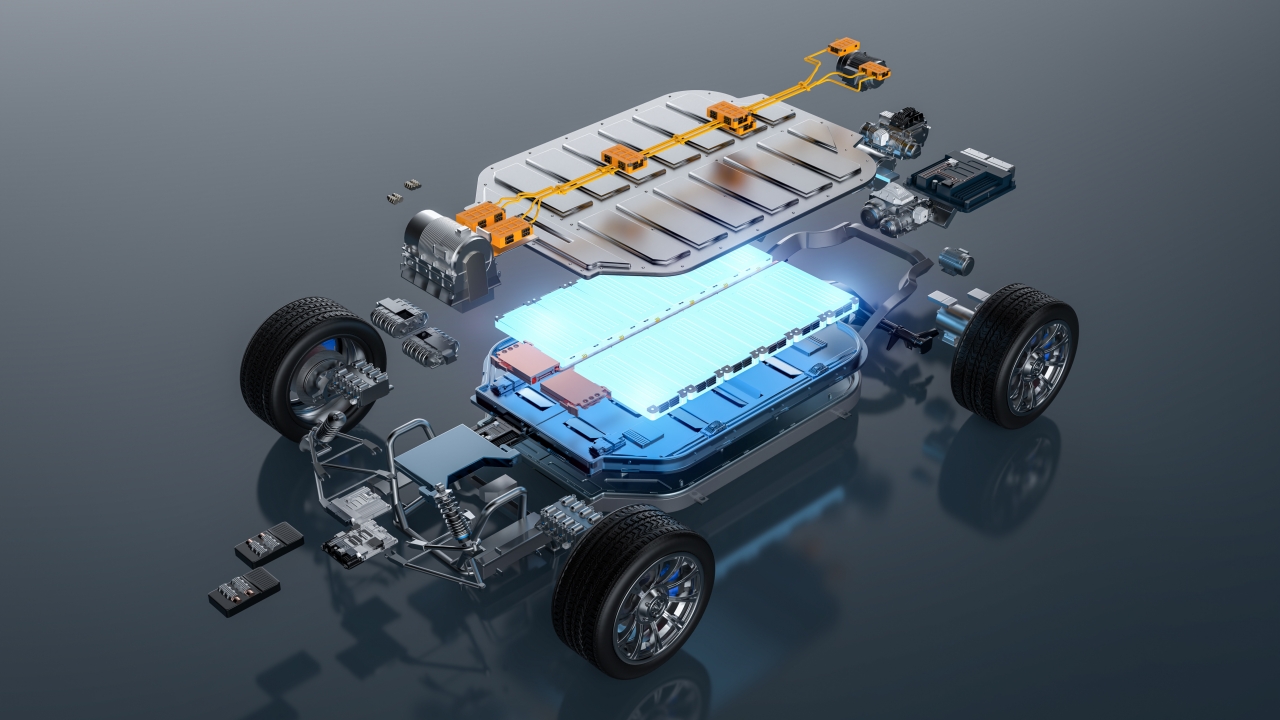
■ Why Do EV Batteries Generate Heat?
In lithium-ion batteries, electrochemical reactions occur inside during charging and discharging.
Furthermore, as current flows, heat is also generated by internal resistance.
In general, heat generation tends to increase the more
● Large currents flow
● Fast charging is done
● High-output discharging is done
● Internal resistance increases
In other words, the higher the performance of a battery, the more important thermal management becomes.
■ Fast Charging and Heat Problems
In EVs, there is a very strong demand to
“shorten charging time.”
To put a large amount of electricity into the battery in a short time, a large current must flow.
However, the larger the current, the more heat is generated.
Raising fast-charging performance and suppressing heat generation are not easily compatible.
If cooling capacity is insufficient, the charging speed must be lowered.
In other words, cooling performance may limit charging performance.
■ For Batteries, High Temperature Is Not the Only Problem
In general electronic devices,
not getting too hot
is the main challenge.
With batteries, however, low temperature is also a problem.
If the temperature is too low,
● Internal resistance may increase
● Output performance may decrease
● Charging performance may decrease
In other words,
overcooling is not good either.
Batteries have a temperature range in which performance and safety are easily balanced, and maintaining them within that range is important.
■ For Batteries, "Average Temperature" Is Not Enough
For example, suppose the average temperature of an entire battery pack is 30°C.
However, if
one cell is 25°C
and another is 40°C,
it is a problem.
If temperatures differ from cell to cell,
● Internal resistance
● Charge/discharge efficiency
● Degradation rate
● Capacity
may also differ.
Then, as time passes, the differences between cells widen.
In other words, in EV batteries, it is important not only to cool the whole,
but to equalize all cells to as close to the same temperature as possible.
■ Temperature Differences Become Life Differences
Hot cells may degrade faster than cooler cells.
Then,
within the same battery pack,
healthy cells
and degraded cells
coexist.
Because a battery pack uses many cells in combination, even if only some cells lose performance, it affects the performance of the whole pack.
In other words,
the worst cell may limit the entire battery pack.
That is why temperature uniformity relates to battery life itself.
■ The More Cells There Are, the Harder Thermal Management Becomes
EV battery packs use many cells.
Even if a single cell is easy to cool,
when hundreds
or thousands
are arranged, cooling conditions differ between
● Cells in the center
● Cells on the periphery
● Cells near the cooling plate
● Cells on the coolant inlet side
● Cells on the outlet side
In other words, it is not the case that lining up identical cells gives the same temperature.
It is necessary to consider the pack’s overall
● Layout
● Cooling flow paths
● Contact state
● Heat spreading
■ Typical Cooling Methods for EV Batteries
For EV batteries, methods such as
● Air cooling
● Liquid cooling
● Cooling plates
● Direct refrigerant cooling
are used.
Today, the more output and capacity increase, the more important liquid cooling becomes.
For example, a structure of
Cell
↓
Thermally conductive material
↓
Cooling plate
↓
Coolant
Heat generated by the cells is sent to the cooling plate through the thermally conductive material, and the coolant flowing inside carries the heat away.
■ Even If the Cooling Plate Is High-Performance, It Will Not Cool Without Contact with the Cells
This is the same as with AI servers.
A high-performance cooling plate.
Sufficient coolant flow.
Low coolant temperature.
Even with these,
if there are gaps between the cells and the cooling plate,
heat does not move sufficiently.
That is why
● Gap fillers
● Thermally conductive sheets
● Thermally conductive adhesives
● TIM
are used.
In other words, even in EV liquid cooling, the “interface” is important.
■ Batteries Require Large-Area Contact
In AI semiconductors, high heat flux concentrates in small heat sources.
Batteries, on the other hand, have the characteristic that many heat sources exist over a wide area.
That is why thermally conductive materials for batteries must not make good contact in only some parts, but
make contact as uniformly as possible over a large area.
This is the difficulty unique to EV batteries.
■ Over Large Areas, Small Thickness Differences Become Big Problems
For example, many cells are brought into contact with a 500 mm wide cooling plate.
The cooling plate.
The cells.
The thermally conductive material.
These are not necessarily perfectly flat.
In one place, there may be
a 0.3 mm gap.
In another place,
a 0.8 mm gap.
That is why
it can be difficult to make contact over the entire surface using only a hard material of uniform thickness.
So dimensional differences and warping are absorbed by flexible gap fillers and the like.
■ A Thicker Gap Filler Is Not Necessarily Safer
Making a soft thermally conductive material thicker can fill larger gaps.
However, the thicker it becomes, the longer
the distance heat travels
becomes.
In other words, there is the relationship:
Thick
→ Easier to conform to steps
→ But thermal resistance tends to increase
Thin
→ Advantageous for heat
→ But cannot absorb steps
In EV batteries, it is necessary to balance the thickness required to fill gaps and
the desire to make it thinner to lower thermal resistance.
■ Compression Ratio Is Also Important
Foams and flexible thermally conductive materials are compressed during assembly.
With appropriate compression, it is possible to
● Conform to surfaces
● Reduce air layers
● Increase contact area
However, if compression is insufficient, gaps remain.
If compressed too much,
● Excessive force may be applied to the cells
● The material may squeeze out sideways
● The thickness may change
● Long-term recovery may decrease
In other words, for thermally conductive materials for batteries, not only thermal conductivity but compression characteristics are extremely important.
■ Cells Can Change Dimensions with Charging and Discharging
Battery cells are not necessarily perfectly constant in dimension.
Depending on
state of charge,
temperature,
and aging,
they may expand slightly.
In other words, inside a battery pack, the gaps themselves may change during use.
That is why thermally conductive materials are required not only to make contact initially, but
to follow the dimensional changes of cells over long periods.
■ Components That Absorb Swelling Are Also Needed
Between cells,
● Foams
● Cushioning materials
● Compression materials
are sometimes placed to absorb cell swelling and vibration.
However, adding such materials also affects
● Heat flow
● Distance between cells
● Pack weight
In other words, cushioning and heat dissipation are not separate problems.
■ Summary
As we have seen, the heat problems of EVs and next-generation batteries do not end with “cooling heat-generating components.”
Fast charging and heat generation are in a trade-off relationship, and cooling capacity may limit charging performance itself.
Furthermore, with batteries, a good average temperature is no reason to relax.
Temperature differences between cells create life differences, and the worst cell limits the performance of the whole pack.
That is why, no matter how high-performance the cooling plate, heat will not reach it if there is lifting or gaps in the thermally conductive material between it and the cells.
Keeping many cells spread over a large area in uniform contact, and over a long period.
Here lies a difficulty unique to batteries, different from AI servers.
In Part 2, we look at another important theme unique to batteries that lies behind the challenge of “cooling”: insulation, flame retardancy and safety.
Column Supervisor: Koji Kakumoto (President, OTIS Co., Ltd.)
After studying abroad and working in planning and development at a trading company, he joined OTIS Co., Ltd. in 2011. While primarily working in the Corporate Planning Department, he has also served concurrently in manufacturing and technical divisions, and since 2018 has served as President, working to drive business growth and strengthen the organization.
This article is a general technical explanation intended for educational purposes and does not refer to any specific company, product, or technology.