■ In Prototyping and Volume Production, Lamination Means Different Things
In prototyping, the goal is “to check whether the performance is achieved.”
In volume production, the goal changes.
In the same position.
At the same pressure.
At the same speed.
The same state.
This must be repeated thousands or tens of thousands of times.
In other words, in volume production, reproducibility matters more than the perfection of a single piece.
■ Hand Application Is a Very Capable Process
People make more sophisticated corrections than one might think.
If the material is slightly crooked, they straighten it.
If air bubbles get in, they push them out.
If an edge lifts, they press it down.
If it is hard to peel, they change the angle.
In other words, in hand application during prototyping, workers correct many abnormalities on the spot.
Automated machines, on the other hand, repeat the set motions.
That is why, if there is variation on the component side, that variation shows up directly in application quality.
■ "A Person Can Apply It" Is Not a Volume Production Condition
The prototype engineer applied 10 sheets neatly.
This is an important confirmation.
But it is not enough to judge volume production capability.
For example, it is necessary to consider
● How many sheets can be applied per hour
● Whether 1,000 sheets can be applied continuously
● Whether it is the same when workers change
● Whether it is the same when material lots change
● Whether it is the same in summer and winter
In other words, being able to apply it and working as a process are different things.
■ Misalignment Directly Affects Thermal Performance
For example, suppose the TIM is shifted 0.5 mm from the semiconductor package.
For large components, the effect may be small.
But for small heat-generating components, a 0.5 mm shift may mean part of the heat-generating surface cannot be covered.
Conversely, if the TIM sticks out,
● It may interfere with surrounding components
● It may affect insulation distance
● Assembly may worsen
In other words, misalignment is not an appearance defect but a problem of thermal performance and safety.
■ Where Does Variation in Application Position Come From?
There is not just one cause.
● Component outer shape tolerance
● Placement accuracy on the carrier
● Deformation during peeling
● Posture during pick-up
● Camera recognition error
● Positional accuracy of the application head
● Positional variation on the target workpiece side
These accumulate.
In other words, the final application accuracy is not determined by processing accuracy alone.
It is determined by the accumulation of tolerances of the component, equipment, recognition and workpiece.
■ The Softer the Material, the Less Stable Its Position
TIM and foams can be soft.
Soft materials conform easily to steps.
But during transport, problems occur such as
stretching,
sagging,
deforming,
and changing shape along the pick-up surface.
In other words, flexibility that is good for thermal performance can become difficulty in handling in the volume production process.
■ The Thinner the Material, the Harder It Is to Handle
Thin-film TIM.
Insulating films.
Graphite.
Making these thinner is advantageous for
● Reducing thermal resistance
● Weight reduction
● Space saving
However, the thinner they become, the more easily
● Wrinkles
● Folding
● Static electricity
● Warping
● Tearing
occur.
In other words, thinning for product performance raises volume production difficulty.
■ Air Bubbles Arise from How It Is Applied
Applying a large-area sheet all at once can trap air.
Especially when air remains in the center, it is hard to remove later.
That is why, in volume production, measures such as
applying in order from one edge,
compression bonding with a roller,
and applying at an angle
are needed.
In other words, air bubble countermeasures are not only about materials, but also about the design of the application motion.
■ Air Bubbles Also Change with Application Speed
In prototyping, it is applied slowly.
In volume production, one wants to shorten the takt time.
That is why the application speed is raised.
Then the material may bond before the air escapes, leaving air bubbles.
In other words,
no problem in prototyping,
air bubbles at volume production speed,
can happen.
■ In Volume Production, "Speed" Becomes a New Condition
One of the biggest differences between prototyping and volume production is takt time.
In volume production, it is necessary to
peel quickly,
transport quickly,
apply quickly,
and compression-bond quickly.
Then
● The viscoelasticity of the material
● Peeling force
● Deformation
● Bonding behavior
also change.
In other words, in volume production, time itself becomes a material condition.
■ If Compression Bonding Conditions Change, the Contact State Also Changes
The contact state of TIM and adhesive components changes with the pressure during compression bonding.
However, volume production equipment uses different methods, such as
● Roller compression bonding
● Press compression bonding
● Head compression bonding
Also,
pressure,
time,
and speed
change.
The state when pressed carefully by finger in prototyping is not necessarily the same as when compression-bonded for 0.5 seconds by an automated machine.
In other words, application conditions are also thermal performance conditions.
■ Pressure Is Not Necessarily Uniform
When applying large-area components with a roller, it may look as though they are being compression-bonded uniformly.
However, the pressure distribution changes with
roller hardness,
workpiece warping,
steps,
and speed.
States are also possible where
only one part is strongly compressed
and another part has insufficient contact.
As a result, thermal resistance varies by location even with the same material.
■ Material Stretching Creates Misalignment
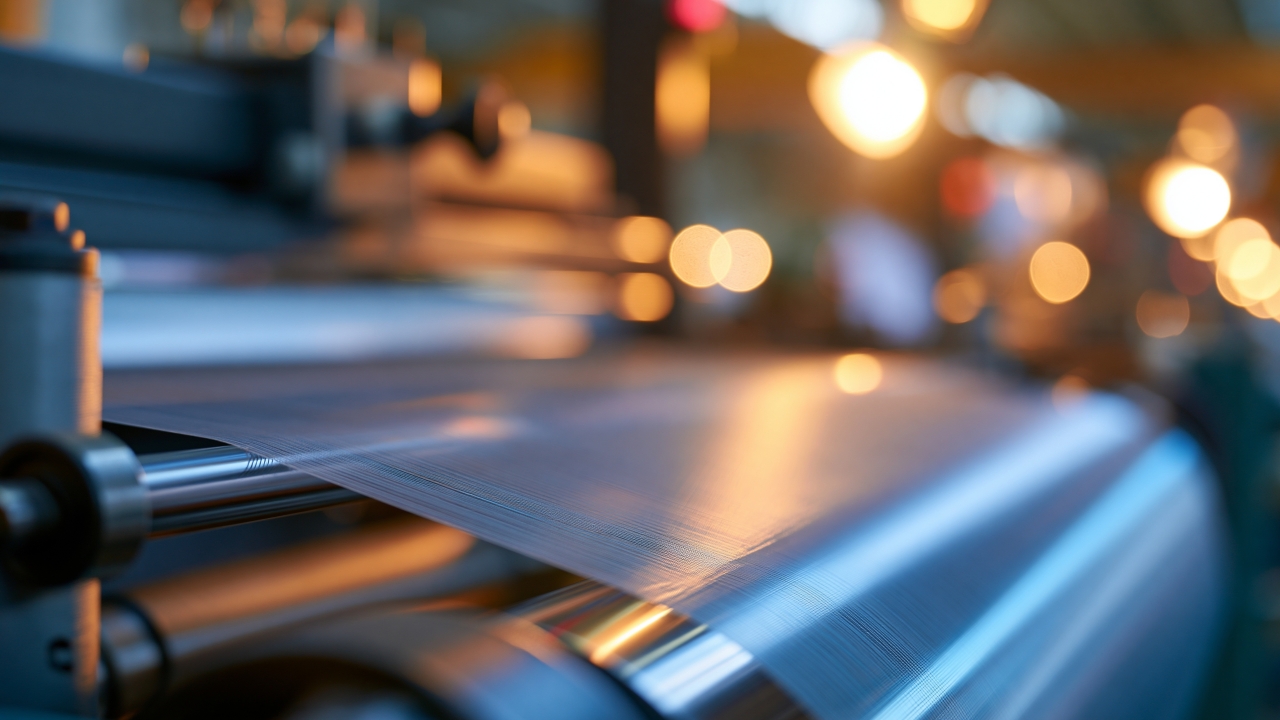
Film materials and thin adhesives can stretch under tension.
For example, in reel-to-reel processing, material is transported at a constant tension.
During processing, the dimensions are correct.
But when the tension is released, it shrinks.
Then the finished product dimensions may change.
In other words, dimensions on the processing machine and dimensions during use are not necessarily the same.
■ In Long-Run Processing, Cumulative Misalignment Also Occurs
The first piece is correct.
The 100th piece is also correct.
But by the 1,000th piece, the pitch has shifted slightly.
This can happen due to
● Material stretching
● Tension fluctuation
● Transport error
● Temperature changes
Even small pitch errors accumulate over long runs.
That is why, in volume production, not only the dimensional accuracy of a single piece, but stability in continuous processing is important.
■ Temperature and Humidity Also Affect Lamination
The properties of adhesives and films can change with temperature and humidity.
In summer, they are soft.
In winter, they are hard.
When humidity is high, material dimensions change.
Peeling force also changes.
It can happen that things were stable in the prototype room, yet at the volume production factory, applicability changes with the season.
In other words, in volume production, environmental conditions are also part of the process conditions.
■ Release Liners Are Also Important Components
It is easy to focus on the thermal management component itself.
But in volume production, release liners are also very important.
In automated machines, the component must be stably peeled from the liner.
Peeling force is too strong.
The component remains on the liner side.
Conversely, it is too weak.
The component moves during transport.
In other words, although the liner does not remain in the product, it is a process material that governs volume production capability.
■ Component Deformation Also Changes with Peeling Angle
When peeling a thin component from a liner, the force applied to the material changes depending on whether the peeling angle is small or large.
Especially with
● Graphite
● Thin-film TIM
● Long, narrow components
they may bend or stretch during peeling.
In other words, in automated application, not only the material shape but even how it is peeled becomes a design target.
■ Some Materials Cannot Be Picked Up
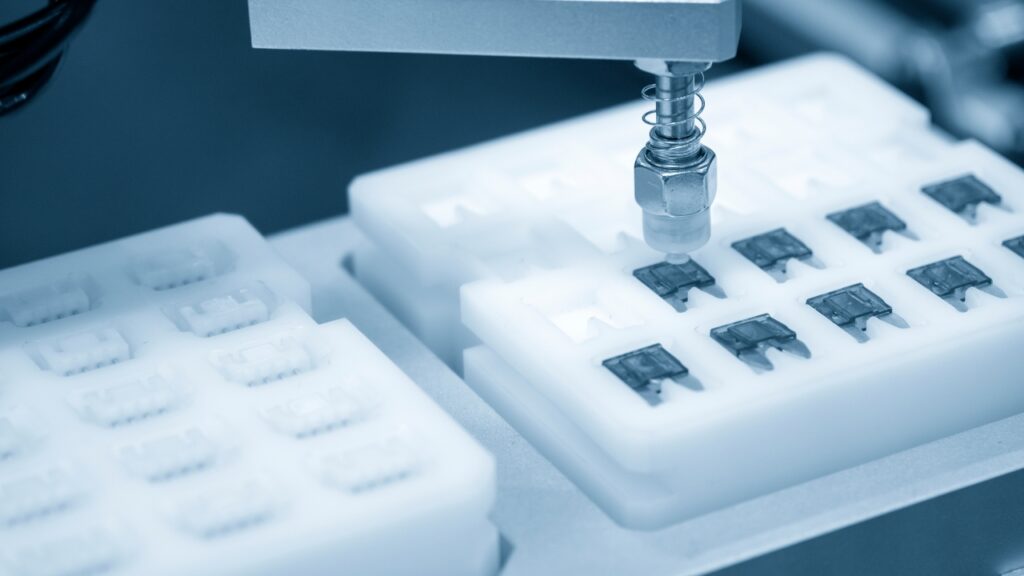
Automated machines often lift components by vacuum suction.
However, depending on the material, because it is
● Porous
● Soft
● Very thin
● Rough-surfaced
it may not be picked up stably.
Then problems occur such as
the component dropping,
the position shifting,
and deformation.
In other words, in automation, not only “whether it can be applied” but also whether it can be held is important.
■ Even If It Can Be Picked Up, It Is Meaningless If It Deforms
Thin graphite was picked up.
But it was pulled locally at the suction holes, and the component warped.
Applying it in that state leads to air bubbles and misalignment.
In other words, in automation, it is necessary to consider even
shape stability during transport.
■ Component Shapes Can Also Be Hard to Automate
Considering only thermal performance, it was made long and narrow.
Complex notches were added.
Very thin bridge sections were made.
Then problems occur: it tears during automated peeling.
It deforms when picked up.
Position recognition is difficult.
In other words, the thermally optimal shape and the shape optimal for volume production do not necessarily coincide.
■ Equipment Conditions Must Be Considered at the Design Stage
If, after volume production starts,
“This shape cannot be handled by automated machines,”
then a design change is needed.
That is why, if possible, it is better to check from the prototype stage
● Pick-up method
● Application direction
● Component pitch
● Carrier width
● Recognition method
● Compression bonding method
In other words, in volume production, it is important to proceed with component design and equipment design at the same time.
■ If Position Cannot Be Recognized, It Cannot Be Automated
Transparent films.
Black graphite.
Highly glossy metal foil.
Such materials can be difficult for image recognition.
Outlines are hard to see.
They reflect light.
They blend into the background.
Then the equipment cannot recognize the exact position.
That is why
● Recognition holes
● Notches
● Asymmetric shapes
● Marks
are sometimes added.
In other words, making shapes easy for equipment to find is also component design.
■ Symmetrical Shapes Can Cause Assembly Errors
A component that looks symmetrical at first glance.
But in reality it has a front/back and an orientation.
Even if an automated machine or worker applies it the wrong way, it is hard to notice from appearance.
That is why assembly errors can be prevented by
● Changing just one notch
● Providing asymmetric holes
● Changing tab positions
In other words, shape design also becomes mistake-proofing (poka-yoke).
■ Summary of Part 1: In Volume Production, the Process, Not People, Must Keep Creating Good Conditions
In prototyping, people make corrections.
If it is crooked, they straighten it. If there are air bubbles, they push them out. If it does not peel, they change the angle.
But automated machines only repeat the set motions.
Variation on the component side shows up directly in application quality.
Even a 0.5 mm misalignment can mean the heat-generating surface cannot be covered.
If application speed is raised, it bonds before the air escapes.
If the compression bonding method changes, the contact state also changes.
Soft materials deform more during transport, and thin materials are more vulnerable to wrinkles and static electricity.
Furthermore, it cannot be peeled. It cannot be picked up. It cannot be recognized.
The thermally optimal shape is not necessarily optimal for volume production.
In other words,
being able to apply it and working as a process are different things.
In Part 2, we look at the solution side.
Integration of components. Reel supply. Process capability control.
And actual failure cases, and what a processing company can do.
Column Supervisor: Koji Kakumoto (President, OTIS Co., Ltd.)
After studying abroad and working in planning and development at a trading company, he joined OTIS Co., Ltd. in 2011. While primarily working in the Corporate Planning Department, he has also served concurrently in manufacturing and technical divisions, and since 2018 has served as President, working to drive business growth and strengthen the organization.
This article is a general technical explanation intended for educational purposes and does not refer to any specific company, product, or technology.