■ Full-Surface Lamination Alone Creates a Lot of Waste
For example, there is a 100 mm square component.
Within it, the heat source is only the central 20 mm square.
But high-performance graphite is applied over the entire surface.
It may work thermally.
However, problems arise:
material costs are high,
weight increases,
and unnecessary areas become conductive.
So
graphite is placed only in the part running from the center toward the enclosure.
High-performance material is used only where needed.
In other words, irregular-shape lamination is also a technology for limiting functional materials to the places they are needed.
■ The More Expensive the Material, the Greater the Value of Partial Placement
High-performance TIM.
High-thermal-conductivity graphite.
Special insulating materials.
Such materials can be expensive.
Using them over the entire surface raises material costs.
But high performance may really be needed in only one area.
For example,
high-performance TIM only directly above the hot spot,
general materials elsewhere.
Such a composition can also be considered.
In other words, irregular-shape lamination may make it possible to deliver the required performance while keeping the amount of high-performance material down.
■ Irregular-Shape Lamination Creates a "Map of Functions"
Look down at a single component from above.
Depending on the location, roles differ:
passing heat,
stopping heat,
insulating,
fixing,
and suppressing EMI.
In other words, multiple functional areas exist within a single component.
Irregular-shape lamination can be thought of as processing that places those functional areas within the surface.
■ Placing Graphite Only in the Direction Heat Should Be Released
Sometimes graphite does not need to be laid over the entire surface.
For example,
we want to release heat from the IC to the left side of the enclosure.
There is a battery on the right side, so we do not want heat to flow there.
In this case, graphite is extended only to the left.
In other words, shape is used to
create the direction in which heat spreads.
In irregular-shape lamination, not only material selection but the shape itself becomes thermal design.
■ Avoiding Directions Where Heat Should Not Flow Is Also Important
In thermal management, it is easy to think only about
where to release heat.
But
where heat must not flow
is also important.
For example,
batteries,
temperature sensors,
surfaces in contact with the human body,
and optical components.
So heat spreaders are notched,
slits are added,
and heat is shielded with other materials.
In other words, irregular-shape lamination can create both heat paths and heat-forbidden areas.
■ TIM Also Becomes Irregular in Shape
TIM goes between the heat source and the cooling component.
But around it there are
capacitors,
screws,
wiring,
and steps.
That is why, rather than a perfect rectangle,
it may become
U-shaped,
L-shaped,
with holes,
or with notches.
In other words, irregular shapes are important in TIM processing too.
■ The Meaning of Reducing Unnecessary TIM Areas
Making TIM wider than necessary may
increase material costs,
interfere with surrounding components,
and create unnecessary heat paths.
That is why it is shaped to match the heat-generating surface and contact surface.
In other words, TIM shape is also part of heat path design.
■ Insulating Materials Sometimes Take "Surrounding" Shapes
Insulating film may take shapes that
surround high-voltage areas,
cover metal edges,
and avoid only the electrode areas.
For example, a structure of
an opening in the center for thermal contact
and insulating film only around it.
In other words, with insulating materials, both the places that remain and the places that are removed have meaning.
■ Metal Foil Is Also Placed Only Where Needed
Placing copper foil or aluminum foil over the entire surface is effective for
heat spreading
and EMI.
However,
weight,
cost,
and unnecessary conductive areas
increase.
So it is placed in irregular shapes only where needed.
For example, designs such as
copper foil running long and narrow from the heat-generating part to the enclosure,
and copper foil only around noise sources.
In other words, irregular-shape metal foil becomes a component that creates heat and electrical paths locally.
■ Adhesives Are Also Made into Irregular Shapes
Rather than
full-surface adhesion,
arrangements such as
adhesive only on the perimeter,
only at the edges,
in dots,
or in rings.
This can sometimes achieve
fixing,
air release,
and lower thermal resistance
at the same time.
In other words, even with adhesives, the position of bonding matters more than the area of bonding.
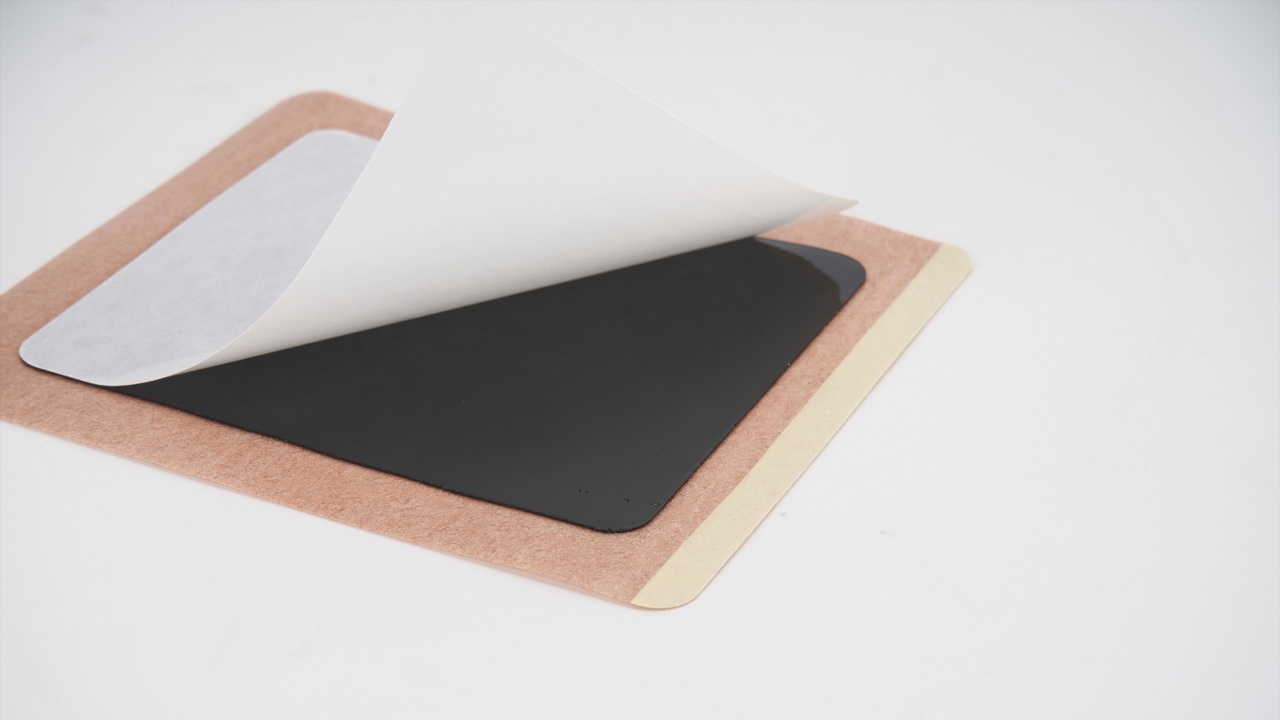
■ The Structure of a Non-Adhesive Center and Adhesive Perimeter
For example, we want to fix TIM.
But we do not want to put an adhesive layer directly under the TIM.
So a structure is made with
a non-adhesive center
and adhesive only on the perimeter.
This way,
fixing
and thermal contact
can both be aimed for.
In other words, irregular-shape lamination is also a technology that separates conflicting requirements by location.
■ Separating Heat Dissipation and Thermal Insulation Within a Single Sheet
Consider an EV battery.
We want to cool the underside of the cells.
We do not want heat to spread between cells.
In this case, a structure is made with
the underside = thermally conductive material,
the sides = thermal insulation material.
In other words, irregular-shape lamination makes it possible to have heat dissipation and thermal insulation coexist within the same product.
■ Boundaries Between Multiple Materials Become Important
Material A
and material B
are placed adjacent to each other.
That boundary shifts.
A gap forms.
They overlap too much.
Then the function changes.
For example,
the boundary between insulating material and metal foil
and the boundary between thermal insulation material and thermally conductive material
are important.
In other words, in irregular-shape lamination, the boundary position between materials becomes a functional dimension.
■ Make a Gap at the Boundary, or Overlap?
Materials A and B are
matched exactly,
overlapped slightly,
or deliberately given a gap.
Which is correct depends on the application.
For example, for insulation, one may want to overlap slightly to provide margin.
Between thermally conductive materials, one wants to eliminate gaps.
In other words, boundary design itself becomes functional design.
■ Overlapping Areas Become Thicker
Different materials are partially overlapped.
Only that overlapping area becomes thicker.
Then
steps,
pressure differences,
and poor contact
may occur.
In other words, in irregular-shape lamination, it is necessary to consider not only position in the XY direction, but also steps in the Z direction.
■ Sometimes Steps Are Used Intentionally
On the other hand, steps can also be used as
spacers,
pressure adjustment,
and positioning.
For example, giving thickness to only one part
creates a constant pressure during assembly.
In other words, in irregular-shape lamination,
thickness distribution can also be made into a function.
■ Creating a Thickness Distribution Within a Plane
Rather than the same thickness over the entire surface,
0.1 mm in this place,
0.3 mm in that place.
Such a structure.
This is hard to achieve with a simple sheet.
It is created by partially laminating multiple thin-film materials.
In other words, irregular-shape lamination is also a technology for creating thin three-dimensional structures, not only two-dimensional shapes.
■ Placing Step-Absorbing Material Only Where Needed
There are local steps on the product surface.
Using thick TIM over the entire surface increases thermal resistance.
So a composition of
thick material only at the step areas
and thin material elsewhere
can also be considered.
In other words, irregular-shape lamination may make it possible to change the optimal thickness by location.
■ Placing Foam Only in Some Areas
There is no need to put foam throughout the entire component.
It is placed only
where pressure is to be applied
and where vibration is to be absorbed.
This keeps
thickness
and weight
down.
In other words, in irregular-shape lamination, surrounding mechanical functions can also be placed locally.
■ Placing Seal Material Only in Some Areas
Seal material is placed only on
the waterproof line,
around openings,
and the enclosure perimeter.
Thermally conductive material in the center.
Such a composition.
In other words,
waterproofing and heat can be separated by location.
■ Continuity Is Important for Waterproof Lines
Perimeter seal material is placed in an irregular shape.
It breaks along the way.
The position shifts.
Then a path for water ingress is created.
In other words, in irregular-shape lamination, it is necessary to guarantee not only outer shape accuracy but the continuity of functional lines.
■ EMI Materials Can Also Be Placed Locally
Only where high-frequency noise is emitted.
Avoiding antennas.
Metal foil and shielding material are placed only where needed.
This makes it easier to balance
EMI,
weight,
and wireless performance.
In other words, irregular-shape lamination is also a technology for avoiding interference between multiple functions.
■ Irregular-Shape Lamination Increases in Smart Devices
The inside of a smartphone is very dense.
Cameras,
antennas,
SoCs,
batteries,
and connectors
are close together.
That is why complex laminates arise, such as
graphite in this shape,
EMI material here,
insulating material only here,
and adhesive on the perimeter.
In other words, the denser the product, the higher the value of irregular-shape lamination.
■ In AI Servers and 3D Packaging, Local Placement of Functions Is Also Important
Around GPUs,
around HBM,
power supply sections,
and optical communication sections
differ in heat generation density.
Rather than the same thermal management over the entire surface,
a composition of
high-performance material at hot spots
and insulation in other areas
may be needed.
In other words, in high-density packaging, optimizing the placement of functions matters more than material performance.
■ EV Batteries Have Large Areas
Insulating materials and thermal management components for EVs can have large areas.
Within them,
bolt holes,
busbar areas,
cooling areas,
and between cells
must be avoided.
In other words, even large components become irregular in shape.
Here, not only fine accuracy, but
positional accuracy and dimensional stability over large areas are needed.
■ Large-Area Irregular Shapes Are Affected by Material Expansion and Contraction
Film of 500 mm or more.
Tension during processing,
temperature,
and humidity
change its dimensions.
Hole positions shift slightly.
The outer shape changes.
In other words, with large-area irregular shapes, material properties and process conditions must be controlled at the same time.
■ In Medical and Wearable Devices, Matching the Shape of the Body
The human body is not flat.
Components are made to follow
arms,
chests,
and waists.
That is why
slits,
divided shapes,
and curves
are used.
Furthermore, there are designs such as
opening only at the sensor area
and adhesive only around the periphery.
In other words, irregular-shape lamination can also be used to create not only functions but also wearability.
■ Divided Designs for Conforming to Curved Surfaces
A single large film wrinkles when applied to a curved surface.
It is divided into multiple narrow areas.
Slits are added.
Then it conforms more easily to curved surfaces.
In other words, through processed shape,
the flexibility of the material can sometimes be effectively increased.
■ Summary of Part 1: Not Stacking Over the Entire Surface, but Creating a Map of Functions
Even in a 100 mm square component, the heat source may be only the central 20 mm square.
Even so, applying high-performance graphite over the entire surface
raises material costs, increases weight, and makes unnecessary areas conductive.
That is why only the necessary functions are placed where needed.
Graphite is extended only in the direction heat should be released.
It is notched so heat does not flow toward the battery.
Only the high-voltage area is insulated, and the thermal contact area is opened.
The center is non-adhesive and only the perimeter is adhesive, achieving both fixing and thermal contact.
For an EV battery, heat dissipation below the cells and thermal insulation between cells.
Multiple functional areas are created within a single component.
In other words, irregular-shape lamination is processing that creates a map of functions within the surface.
And this is not only about the XY direction.
Where materials overlap, they become thicker.
That step may cause poor contact,
or conversely may be used as a spacer or for pressure adjustment.
Furthermore, shape also changes the properties of the material itself.
Adding slits lets even a stiff sheet conform to curved surfaces.
In other words,
not only choosing materials, but where and how to place them becomes design.
However, this idea is not easy in volume production.
In Part 2, we look at the difficulties and their solutions.
Column Supervisor: Koji Kakumoto (President, OTIS Co., Ltd.)
After studying abroad and working in planning and development at a trading company, he joined OTIS Co., Ltd. in 2011. While primarily working in the Corporate Planning Department, he has also served concurrently in manufacturing and technical divisions, and since 2018 has served as President, working to drive business growth and strengthen the organization.
This article is a general technical explanation intended for educational purposes and does not refer to any specific company, product, or technology.