■ Why Do Metals Conduct Heat Well?
The reason metals conduct heat well lies in the presence of free electrons.
Inside metals, electrons move easily,
and they can also carry thermal energy efficiently.
That is why
● Copper
● Aluminum
● Silver, and so on have high thermal conductivity.
For example, comparing the thermal conductivity of typical materials,
● Air: approx. 0.026 W/mK
● Resin: approx. 0.2 W/mK
● Silicone heat dissipation materials: approx. 1–10 W/mK
● Aluminum: approx. 200 W/mK
● Copper: approx. 400 W/mK
In other words, copper conducts heat hundreds to thousands of times more easily than resin.
■ What Is Metal Foil?
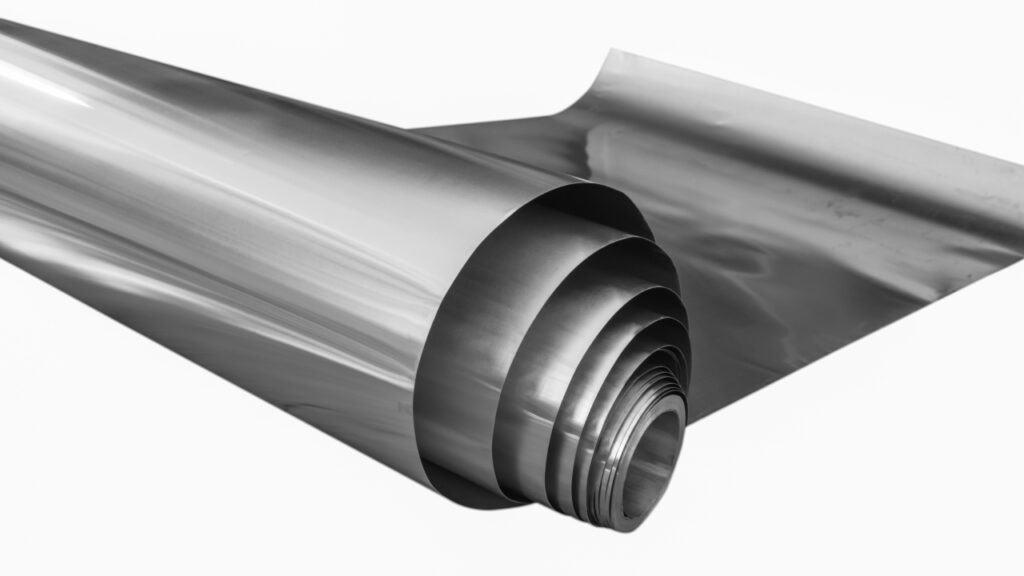
Metal foil is a metal material processed to be extremely thin.
Generally,
● Copper foil
● Aluminum foil
● Stainless steel foil
● Nickel foil, and so on are used.
In thermal management applications,
copper foil and aluminum foil are mainly used.
■ Characteristics of Copper Foil
Copper has extremely high thermal conductivity.
That is why it excels at moving heat quickly.
In AI servers and around semiconductors,
it is sometimes used to diffuse locally generated heat over a wide area.
In addition, because it can also serve
● EMI countermeasures
● Shielding applications
● Grounding applications
it is advantageous in designs that consider heat and noise at the same time.
On the other hand, there are also challenges, such as being
● Heavy
● Expensive
● Hard to bend
■ Characteristics of Aluminum Foil
Aluminum has lower thermal conductivity than copper.
However, it has the advantages of being
● Light
● Inexpensive
● Easy to process
That is why aluminum is also often used in EVs, ESS, home appliances, communication equipment, and so on.
Especially in applications where weight reduction is important, aluminum is sometimes chosen over copper.
■ Metal Foil "Spreads" Heat
An important role of metal foil is spreading heat.
For example, if a heat-generating component is only 1 cm square,
only the area around it becomes hot.
If copper foil or aluminum foil is placed here, heat diffuses over a wider area.
Then the local temperature tends to drop.
This is a role similar to that of graphite.
■ The Difference from Graphite
Graphite is also a material that spreads heat.
So what is the difference?
The major difference is isotropy versus anisotropy.
Copper and aluminum conduct heat relatively uniformly.
Graphite, on the other hand, is often strong in the in-plane direction and weak in the thickness direction.
In other words, metals are relatively easy to handle, while graphite must be used with its directionality in mind.
■ Metal Foil Alone Does Not Solve the Problem
There is an important misconception here.
Using copper with high thermal conductivity does not solve everything.
In reality, it must be considered in terms of the entire heat path:
Heat-generating component
↓
TIM
↓
Copper foil
↓
Heat spreader plate
↓
Enclosure
↓
Air
If heat gets clogged at even one point,
sufficient heat dissipation cannot be achieved.
■ How It Is Used in AI Servers
In AI servers, GPUs and power supply circuits generate large amounts of heat.
That is why
● Copper plates
● Copper foil
● Heat spreaders
● Liquid cooling plates, and so on are used.
Especially recently, how uniformly heat can be spread has become more important than cooling technology.
■ How It Is Used in EVs and ESS
In EVs and ESS, temperature differences between battery cells are a problem.
When temperature differences are large,
● Differences in degradation rate
● Differences in capacity
● Shorter lifespan
● Risk of thermal runaway
occur.
That is why designs that equalize heat using metal foils and metal plates are sometimes used.
In other words, in EVs, not only cooling,
but also reducing temperature differences is important.
■ The Researcher's Perspective: Metal Foil Is an Old Yet New Material
Copper and aluminum have existed for a long time.
However, with the evolution of
AI servers
3D semiconductors
EVs
ESS, they are attracting attention again.
Recently, research is advancing on
● Ultra-thin foils
● Multilayering
● Lamination of dissimilar materials
● Composite heat dissipation structures
and more.
■ The Shop-Floor Perspective: When Metal Is Processed, Other Problems Arise
On the shop floor, processability can be more of a problem than thermal conductivity.
For example,
● Burrs
● Wrinkles
● Warping
● Cracks
● Lamination defects, and so on.
In addition, because metal is soft, the thinner it gets, the more difficult it is to handle.
In other words, both thermal performance and processability must be achieved.
■ Problems That Tend to Occur in Volume Production of Metal Foils
In volume production processes,
● Deformation of fine shapes
● Die-cutting burrs
● Folding during transport
● Lamination misalignment
● Generation of metal particles
● Curl from winding, and so on can occur.
Even if a material is excellent for thermal management, it is meaningless if it cannot be supplied stably in volume production.
■ OTIS's Perspective
OTIS is not a company that manufactures copper foil or aluminum foil themselves.
However, through
● Fine die-cutting
● Irregular-shape processing
● Lamination processing
● Lamination with insulating materials
● Reel supply
● Support for automation
we may be able to contribute to bringing metal foils closer to a form that can be used in volume production.
Especially in configurations that achieve not only thermal management but also EMI countermeasures, insulation, and adhesion at the same time,
processing technology becomes more important.
■ What OTIS Can Do
At OTIS, through
● Copper foil processing
● Aluminum foil processing
● SUS foil processing
● Special ultra-thin foil processing
● Fine die-cutting
● High-precision lamination
● Lamination of dissimilar materials
● Reel supply
● Supply design for automated processes, and so on,
we may be able to support bringing metal foils into volume production processes.
■ Outside OTIS's Expertise
On the other hand, OTIS is not a company that specializes in
● Copper foil manufacturing
● Aluminum refining
● Metal material development
● Cooling equipment design
● Dedicated CFD thermal analysis
However, in the area of processing metal foils into easy-to-use forms and making them work in volume production,
we may be able to deliver value.
■ Industries Where This Technology Will Be Important
★★★★★ AI servers
★★★★★ Data centers
★★★★★ EVs and batteries
★★★★★ ESS and energy storage systems
★★★★☆ Semiconductor manufacturing equipment
★★★★☆ Communication equipment
★★★★☆ Robots
■ Summary
Metal foil is still the main player in thermal management
New thermal management materials are appearing one after another.
In reality, however, copper and aluminum are still the central materials of thermal management.
The reason is simple: they can carry heat efficiently.
And in future AI servers, EVs, and ESS,
not only how quickly heat can be released,
but also how uniformly heat can be spread will be important.
In that sense, metal foil can be called an old yet new thermal management material.
Column Supervisor: Koji Kakumoto (President, OTIS Co., Ltd.)
After studying abroad and working in planning and development at a trading company, he joined OTIS Co., Ltd. in 2011. While primarily working in the Corporate Planning Department, he has also served concurrently in manufacturing and technical divisions, and since 2018 has served as President, working to drive business growth and strengthen the organization.
This article is a general technical explanation intended for educational purposes and does not refer to any specific company, product, or technology.