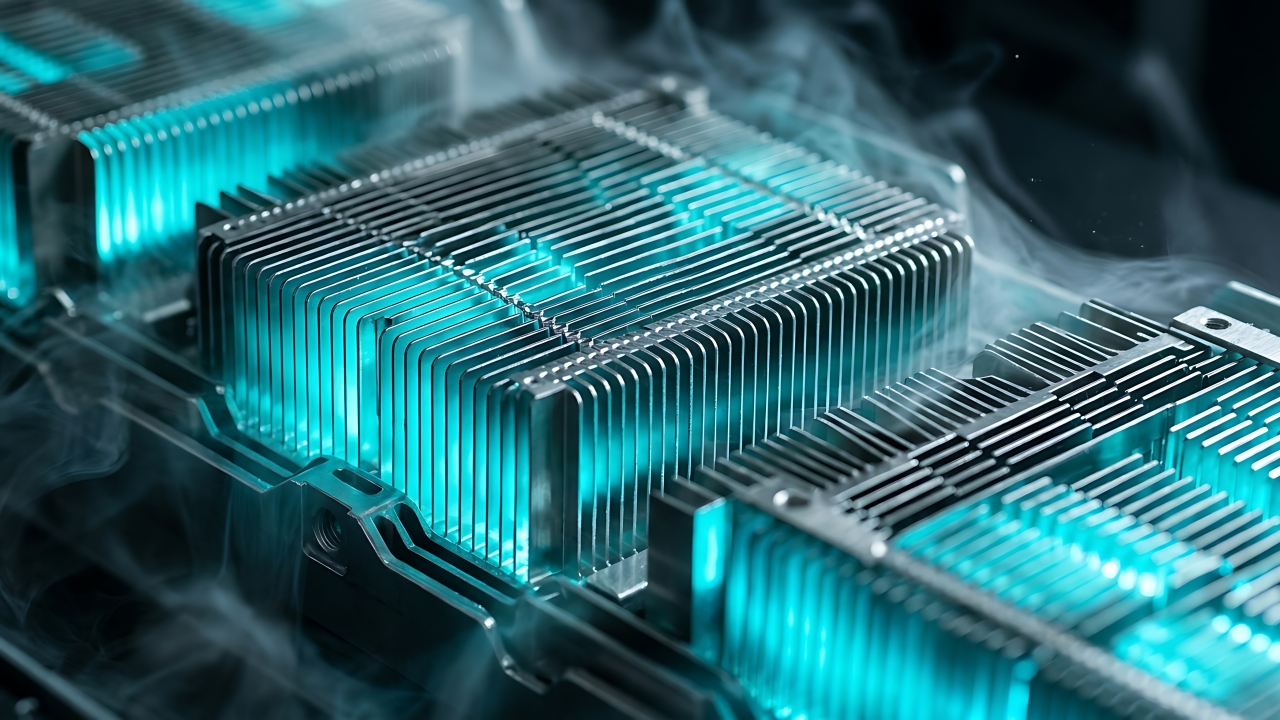
■ How Does Air Cooling Release Heat?
For example, when a semiconductor is air-cooled, heat generally passes along the path
Semiconductor
↓
TIM
↓
Heat sink
↓
Air
Heat generated by the semiconductor is transferred to the heat sink via the TIM.
The heat sink spreads the heat.
Then heat is handed from the surface of the heat sink to the air.
The fan sends the warmed air outside and replaces it with fresh air.
In other words, air cooling is a technology that carries heat outside on the air.
■ Why Do Heat Sinks Have Fins?
To hand a lot of heat to the air, the area in contact with the air must be increased.
That is why heat sinks have many fins.
The fins increase surface area, and the fan blows air over them.
Basically, cooling capacity is increased by
・Spreading heat
・Increasing surface area
・Flowing air
It is a very rational method.
However, as heat generation increases, the limits of this method also begin to show.
■ Increasing Airflow Can Raise Cooling Capacity
A typical way to raise air cooling capacity is increasing airflow.
Raise the fan speed.
Use a larger fan.
Increase the number of fans.
This allows warm air around the heat sink to be exhausted faster.
At the same time, however, problems arise such as
・Power consumption increases
・Noise gets louder
・Vibration increases
・Space is needed for fans
・The number of parts that can fail increases
In other words, in air cooling, the more cooling performance is raised, the more other burdens increase.
■ Heat Sinks Cannot Be Made Infinitely Large Either
To increase the area for handing heat to the air, heat sinks can also be made larger.
However, in
・Smartphones
・Wearable devices
・Robots
・High-density servers
it is difficult to secure a large space just for cooling parts.
Making the heat sink larger causes problems such as
・The product becomes larger
・It becomes heavier
・Other parts cannot be placed
・Airflow paths are also affected
In other words, a contradiction arises: you want to make the product smaller,
yet thermal management wants a large area.
■ What Becomes a Problem in the AI Era Is "Heat Generation Density"
When considering the difficulty of air cooling, simple heat generation alone is not enough.
What matters is heat generation density.
Even with the same 100 W of heat generation, the difficulty differs between heat generated from a large area and heat generated from a small semiconductor chip.
When heat generation concentrates in a small area, local temperatures rise easily.
In AI semiconductors,
・Higher performance
・Miniaturization
・High-density mounting
・Close placement with HBM and the like
are advancing.
In other words, things are moving in the direction of
more heat coming out of a smaller place.
This change is making air cooling difficult.
■ Strengthening the Fan May Not Cool It
This is important.
Just because a semiconductor is hot does not necessarily mean fan capacity is insufficient.
Heat moves along
Semiconductor
↓
TIM
↓
Heat sink
↓
Air
For example, if the TIM has
・Air bubbles
・Lifting
・Excessive thickness
・Insufficient contact
heat cannot be sufficiently handed from the semiconductor to the heat sink.
In this case,
even if the fan is strengthened, the chip temperature does not drop sufficiently
in some cases.
This is because the heat bottleneck lies not beyond the heat sink,
but before it.
When considering air cooling performance too, it is necessary to look at
the entire heat path from the heat source to the air.
■ With Higher Density, Air Itself Stops Flowing Through
Air cooling requires space for air to flow.
However, as electronic devices become denser,
・Boards
・Connectors
・Cables
・Power supply components
・Memory
・Cooling components
increase, and air passages become narrower.
Air does not necessarily flow to the places you want to cool.
It escapes to places with less resistance.
It stagnates in some places.
Warm air is drawn in again.
These phenomena occur.
In other words, with higher density, alongside design for placing electronic components,
design for letting air through is also needed.
■ In Data Centers, It Becomes a Problem of the Entire Building
In AI servers, handing the heat from inside the server to the air is not the end.
That heat must ultimately be discharged outside the building.
Heat moves
Semiconductor
↓
Heat sink
↓
Server interior
↓
Rack
↓
Server room
↓
Air-conditioning equipment
↓
Outdoors
As heat generation per rack increases, the required amount of air also increases.
Then even
・Fans
・Air conditioning
・Ducts
・Separation of cold and hot air
・Building facilities
become larger.
In other words, the heat problem of AI data centers spreads from a chip cooling problem to
a heat-handling problem for the entire building.
■ Air Cooling Also Uses Power for Cooling
AI servers use a large amount of power for computation itself.
And they also use power to remove the heat generated as a result.
Running fans.
Operating air conditioning.
Circulating air in the room.
In other words, it becomes a structure of
Using power
↓
Heat is generated
↓
Using even more power to discharge that heat
The further heat generation increases,
the more cooling efficiency itself becomes system performance.
■ The Limit of Air Cooling Cannot Be Decided by "How Many Watts"
There is the question, “Above how many watts is air cooling impossible?”
However, it is difficult to decide simply by a single number.
Air cooling capacity changes with
・Heat generation area
・Heat generation density
・Ambient temperature
・Heat sink
・TIM
・Airflow
・Product size
・Allowable noise
・Usage environment
Even with the same heat generation, air cooling may be possible if heat can be spread over a wide area.
Conversely, if heat is concentrated in a small place, even relatively small heat generation becomes difficult.
In other words,
the limit of air cooling is determined not only by heat generation, but by the conditions of the entire product.
■ The Real Limit Is That "Air Cooling No Longer Pays Off"
If you want to raise air cooling capacity, you can
・Strengthen fans
・Add fans
・Enlarge heat sinks
・Widen flow paths
・Raise air-conditioning capacity
As a result, however,
・Power
・Noise
・Weight
・Space
・Cost
・Maintenance burden
increase.
That is why the limit of air cooling is not that it suddenly stops cooling at some moment.
It is that the price of maintaining air cooling becomes too great.
This is the turning point for considering next-generation cooling technologies such as liquid cooling.
■ It Does Not Switch All at Once from Air Cooling to Liquid Cooling
Even as next-generation cooling advances, air cooling will not disappear.
For example,
only high-heat GPUs are liquid-cooled.
Other components are air-cooled.
Heat is carried by liquid and finally dissipated to the air.
Such combinations also exist.
In other words, it is not a binary choice of air cooling or liquid cooling.
Use the necessary cooling method in the necessary place.
From now on, it will become an era of choosing the optimal heat path for each heat source.
■ The Researcher's Perspective: The Limit of Air Cooling Is Not Determined by "Heat" Alone
Physically, cooling capacity can sometimes be raised by using a larger heat sink and a stronger fan.
However, products have constraints such as
・Size
・Weight
・Noise
・Power
・Cost
・Waterproofing
・Maintainability
Therefore, being able to cool and holding up as a product are not the same.
The limit of air cooling is determined not only by thermal performance, but by the balance with the requirements of the entire product.
■ The Shop-Floor Perspective: Just Because the Temperature Is High, Do Not Suspect Only the Fan
When insufficient cooling occurs,
“Let’s increase airflow,”
one is tempted to think.
However, if the cause is
・Lifting of the TIM
・Insufficient contact
・Poor mounting of the heat sink
・Clogging of airflow paths
・Recirculation of exhaust air
strengthening the fan will not be a fundamental solution.
In heat problems, it is important to search for where heat is stopping.
■ OTIS's Perspective
OTIS is not a company that designs fans or heat sinks.
However, even in air cooling, before heat is handed to the air, it is necessary
to deliver heat correctly from the heat-generating body to the cooling component.
In between, materials such as
・TIM
・Heat dissipation sheets
・Graphite
・Metal foils
・Insulating films
・Adhesives
are used.
If these components have
・Lifting
・Air bubbles
・Burrs
・Thickness variation
・Misalignment
the performance of heat sinks and fans cannot be fully utilized.
In other words, where OTIS can contribute is
not the air cooling equipment itself, but the interface between the heat source and the cooling component.
■ What OTIS Can Do
At OTIS, through
・TIM processing
・Heat dissipation sheet processing
・Graphite processing
・Copper foil and aluminum foil processing
・Insulating film processing
・Adhesive processing
・High-precision lamination
・Fine die-cutting
・Support for reel supply and automated application
we may be able to contribute to processing the heat path from the heat source to the cooling component into components that can be mass-produced.
■ Outside OTIS's Expertise
OTIS is not a company that specializes in
・Fan design
・Heat sink design
・Data center air-conditioning design
・Dedicated CFD analysis
・Design of entire cooling systems
These are areas where we work with material manufacturers, cooling equipment manufacturers and customers as needed.
■ Industries Where This Technology Will Be Important
★★★★★ AI servers and data centers
★★★★★ Semiconductors and advanced packaging
★★★★☆ Communication equipment
★★★★☆ Robots and automation equipment
★★★★☆ Automotive electronics
★★★★☆ Industrial equipment
■ Summary
The limit of air cooling is not that air can no longer cool
Air cooling will remain an important cooling technology.
However, AI semiconductors and high-density electronic devices are moving in the direction of
・Heat generation increasing
・Heat generation density rising
・Space inside products decreasing
Trying to raise air cooling capacity in response requires
・Larger heat sinks
・Greater airflow
・More power
・More space
That is why the limit of air cooling is
not a limit of “air cannot cool.”
It is a limit where “the price of cooling with air alone becomes too great.”
And the closer we get to this limit, the more cooling technology moves
in the direction of recovering heat closer to the heat source.
Liquid cooling.
Vapor chambers.
Cooling for 3D integration.
Next-generation cooling technologies do not deny air cooling.
They are an evolution to make up for the parts that have become difficult with air cooling alone.
Column Supervisor: Koji Kakumoto (President, OTIS Co., Ltd.)
After studying abroad and working in planning and development at a trading company, he joined OTIS Co., Ltd. in 2011. While primarily working in the Corporate Planning Department, he has also served concurrently in manufacturing and technical divisions, and since 2018 has served as President, working to drive business growth and strengthen the organization.
This article is a general technical explanation intended for educational purposes and does not refer to any specific company, product, or technology.