【1】Introduction
The invention of the transistor in 1947 brought the vacuum tube era to a close and drove a rapid wave of miniaturization and performance improvement in electronic devices.
However, in the era when transistors were wired together individually, a range of problems piled up:
・Increasingly complex wiring
・Signal delay
・Cost and reliability issues
The integrated circuit (IC) fundamentally transformed this situation.
【2】What Is an Integrated Circuit (IC)?
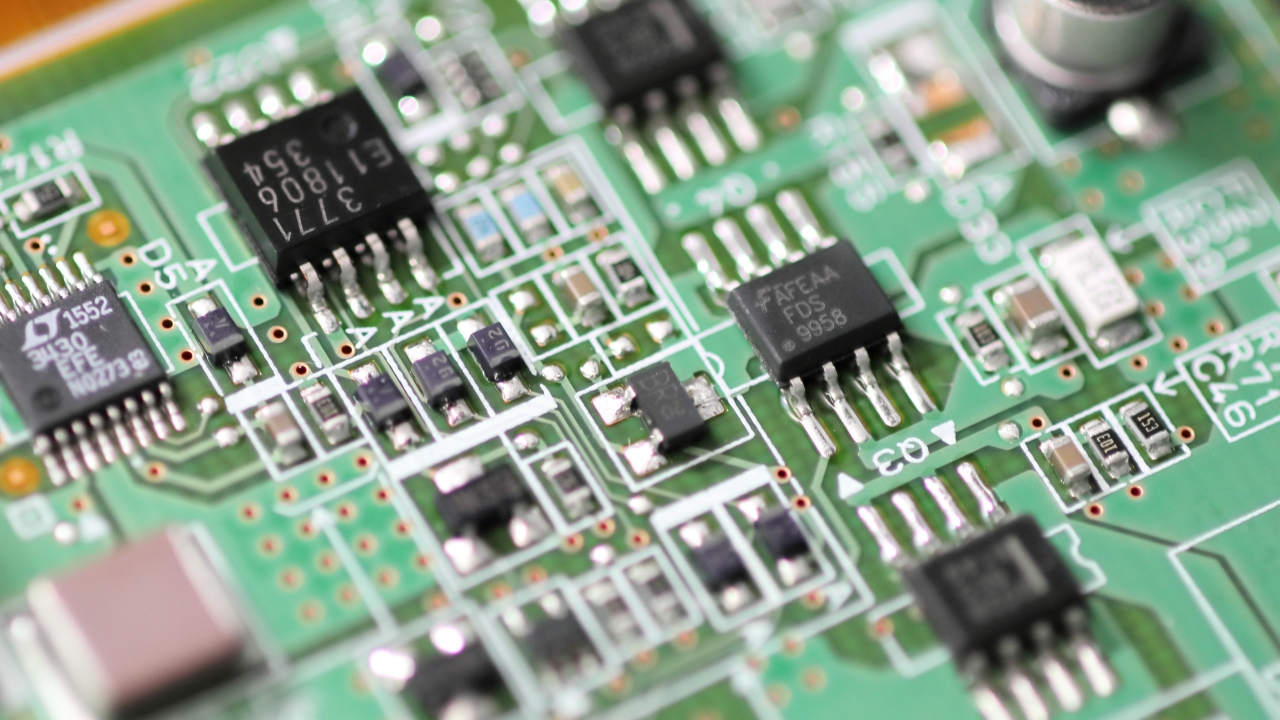
An IC is a circuit in which multiple electronic components — transistors, resistors, capacitors, and more — are formed together on a single semiconductor substrate.
In other words, it is an entire electronic circuit condensed onto a chip. This dramatically shortened the distance signals had to travel, leading to major improvements in speed, power efficiency, and reliability.
【3】The Birth of the IC and Its Early Development
・1958: Jack Kilby of Texas Instruments invented the first integrated circuit.
・1959: Robert Noyce of Fairchild Semiconductor realized an IC built on a silicon substrate.
This marked the starting point for the semiconductor integration technology that continues to this day.
Early ICs contained only a few dozen transistors and were classified as SSI (Small Scale Integration).
【4】Stages in the Evolution of Integration Density
Semiconductor integration technology is classified according to the number of transistors integrated onto a chip:
・SSI (Small Scale Integration): A few dozen transistors (1950s–60s)
・MSI (Medium Scale Integration): A few hundred transistors (early 1970s)
・LSI (Large Scale Integration): Thousands to tens of thousands of transistors (late 1970s)
・VLSI (Very Large Scale Integration): Hundreds of thousands to millions of transistors (1980s–90s)
・ULSI (Ultra Large Scale Integration): Tens of millions to hundreds of millions of transistors (2000s onward)
Today, a single chip can contain tens of billions of transistors.
【5】Types of Integrated Circuits
Integrated circuits fall broadly into two categories:
1.Analog ICs: Circuits that process continuous signals. Representative examples include operational amplifiers, power ICs, and sensor circuits.
2.Digital ICs: Circuits that handle discrete signals represented as 0s and 1s. Representative examples include logic ICs, microprocessors, and memory.
Many systems today use mixed-signal ICs, which combine both analog and digital circuitry.
【6】Technologies That Support Integrated Circuits
Realizing an IC requires several essential supporting technologies:
・Fine-pattern processing technology (lithography, etching)
・Impurity doping technology
・Formation of insulating layers (oxidation, CVD)
・Wiring (formation of metal layers)
・Packaging and mounting
Together, these technologies work in concert to achieve structures measured on the nanometer scale.
【7】Characteristics of LSI (Large Scale Integration)
From the LSI era onward, integration moved beyond simply packing in more components toward integrating functionality itself. A single chip could now handle computation, memory, control, and communication all at once.
Examples include:
・CPU (computation)
・GPU (image processing)
・DSP (signal processing)
・SoC (System on Chip — integrated multi-function device)
As a result, a single smartphone became capable of outperforming the supercomputers of an earlier era.
【8】The VLSI (Very Large Scale Integration) Era
Entering the 1980s, the advancement of CAD (computer-aided circuit design) enabled an explosive increase in transistor counts.
The VLSI era brought about the following technological breakthroughs:
・Finer manufacturing processes (moving from the micrometer scale to the nanometer scale)
・The shift to CMOS (reducing power consumption)
・Multilayer wiring
・Automated design (EDA tools)
These advances are what made Moore’s Law — the doubling of transistor density every 18 to 24 months — a practical reality.
【9】Modern Ultra-High Integration (ULSI to 3D IC)
Today, integration density is advancing not only through miniaturization but also through three-dimensional structures:
・3D stacking enabled by TSV (Through Silicon Via) technology
・Modularization through chiplet architectures
・Heterogeneous integration, combining different types of devices
This has ushered in a new era in which performance, power efficiency, and design flexibility can all be achieved simultaneously.
【10】Future Outlook
Going forward, integration technology is expected to shift from simple miniaturization toward optimization and specialization:
・Structural expansion through 3D ICs and chiplet architectures
・Optimized layout design supported by AI
・Convergence with quantum devices and photonic integrated circuits
・Modular optimization through in-package integration (2.5D/3D system-in-package designs)
In short, the industry is moving away from relying on a single chip and toward systems in which multiple chips work together in coordination.
【11】Summary
・An IC is a device in which multiple electronic components are integrated onto a single chip.
・Integration density has progressed through the stages SSI → MSI → LSI → VLSI → ULSI.
・From the LSI era onward, integration evolved toward functional integration, such as SoCs, CPUs, and GPUs.
・Today, the industry has entered an era of combined optimization, driven by 3D structures, chiplets, and AI-assisted design.
Comprehension Check
1.What is the greatest advantage of the integrated circuit (IC)?
2.What do LSI and VLSI mean?
3.What direction is integration technology heading in going forward?
Column Supervisor: Koji Kakumoto (Otis Group Co., Ltd.)
After studying abroad and working in planning and development at a trading company, he joined Otis Group Co., Ltd. in 2011. While primarily working in the Corporate Planning Department, he has also served concurrently in manufacturing and technical divisions, and since 2018 has served as Representative Director, working to drive business growth and strengthen the organization.
This article is a general technical explanation intended for educational purposes and does not refer to any specific company, product, or technology.