【1】Introduction
Memory is a semiconductor device that holds information, either temporarily or permanently.
If the CPU is the “brain,” memory is the “storage system.”
No matter how powerful a processor is, processing grinds to a halt if memory is too slow.
【2】Classification of Memory (Volatile / Non-Volatile)
Memory falls into two broad categories, based on whether it retains data when power is turned off:
・Volatile memory: Data is lost when power is turned off. It operates at high speed and is used for primary memory. Examples: DRAM, SRAM.
・Non-volatile memory: Data is retained even when power is turned off. Examples: flash memory (NAND/NOR), ROM, EEPROM.
【3】The Structure and Characteristics of SRAM (Static RAM)
・Each bit is formed from six transistors (four MOS transistors plus two access transistors).
・Because it continuously retains its charge, no refresh (rewriting) is required.
・It operates at high speed and is used for cache memory.
・Drawback: a relatively large cell area, resulting in higher cost.
Applications: CPU internal cache, FPGA internal buffers, GPU internal registers.
【4】The Structure and Characteristics of DRAM (Dynamic RAM)
・Each bit is formed from a single transistor plus a single capacitor.
・Because charge naturally leaks away over time, periodic refreshing is required to retain data.
・Well suited to high density and large capacity.
・Slower than SRAM, but low cost, making it ideal for main memory.
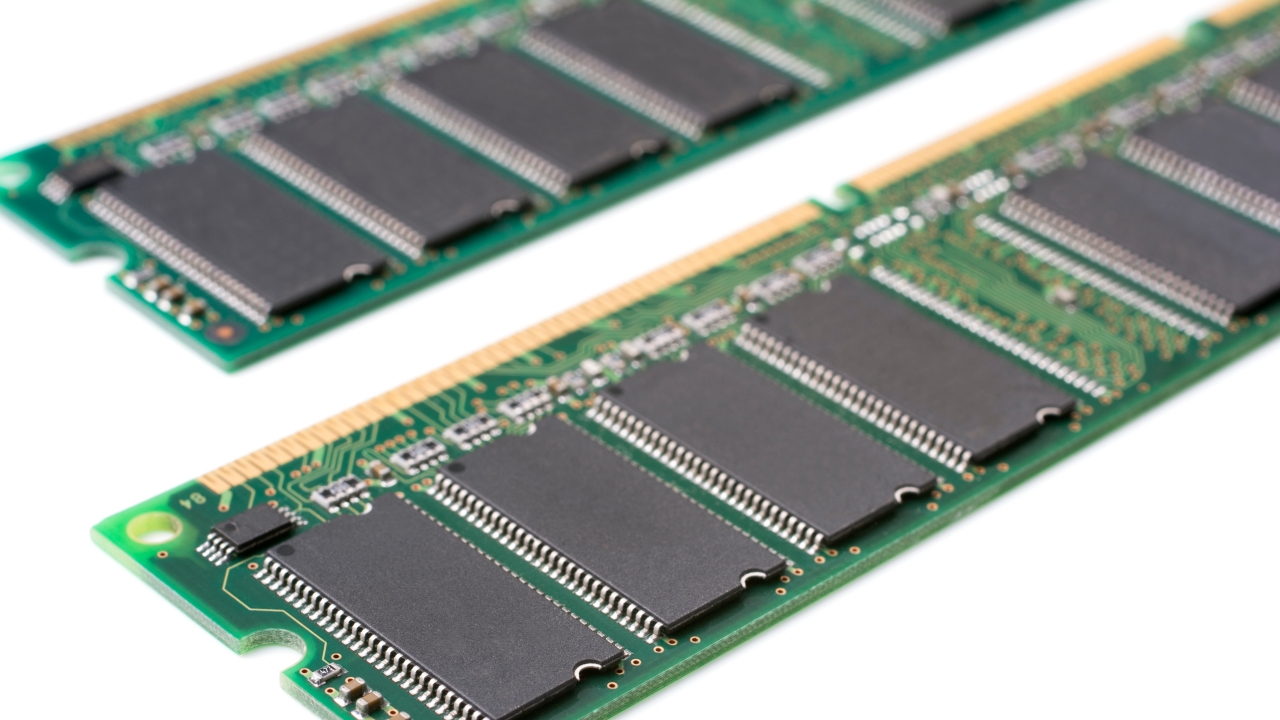
Applications: Main memory in PCs and smartphones, server DIMMs.
【5】ROM (Read Only Memory)
・A read-only memory type whose contents are written during manufacturing.
・Used to store programs and firmware.
・Once written, its contents cannot be changed, but it offers high reliability.
Types:
・Mask ROM: Contents are fixed during the manufacturing process.
・PROM: Users can write to it a single time.
【6】EEPROM (Electrically Erasable Programmable ROM)
・A type of ROM whose data can be electrically erased and rewritten.
・The technology that served as the prototype for flash memory.
・Offers long data retention and high resistance to repeated erasing.
Applications: Storing microcontroller settings, IC cards, recording sensor calibration values.
【7】Flash Memory
Flash memory is one of the most important types of non-volatile memory. Its data can be electrically rewritten, and it offers large capacity, low power consumption, and low cost.
Structure:
・Uses a floating-gate MOSFET.
・Records “1” (charge present) or “0” (no charge) by trapping electrons within the gate.
Main types:
・NOR type: Fast read speed (used for code storage)
・NAND type: High density and large capacity (used for storage applications)
【8】The Structure and Applications of NAND Flash
・Achieves high density by connecting cells in series.
・Data is erased and written in units called blocks.
・Rewrite speed is relatively slow, but it is well suited to achieving large capacity.
Applications: SSDs, USB flash drives, smartphone storage, SD cards, and more.
【9】Next-Generation Memory Technologies
To overcome the limitations of conventional memory — including endurance, speed, and power consumption — new memory technologies based on different physical principles are being researched:
・MRAM (Magnetoresistive RAM): Uses electron spin. Fast and highly durable.
・ReRAM (Resistive RAM): Uses changes in resistance. Low power consumption.
・PCRAM (Phase Change RAM): Retains information through crystalline and amorphous states of a material.
・FeRAM (Ferroelectric RAM): Uses ferroelectric materials. Extremely fast with low power consumption.
These technologies are drawing attention as candidates for next-generation memory that is both non-volatile and fast.
【10】Memory Hierarchy
Computers use a hierarchical memory structure to balance speed and capacity.
Generally, higher levels are faster, more expensive, and smaller in capacity, while lower levels are slower, cheaper, and larger in capacity:
1.Registers (inside the CPU)
2.Cache memory (SRAM)
3.Main memory (DRAM)
4.Storage (such as NAND-based SSDs)
5.External storage (HDDs, cloud storage)
This hierarchical design allows processing performance and cost to be optimized together.
【11】Summary
・Memory is a semiconductor device used to retain information.
・Volatile memory includes SRAM and DRAM; non-volatile memory includes ROM and flash memory.
・NAND flash is the mainstream technology for storage.
・Next-generation non-volatile memory technologies, such as MRAM and ReRAM, are steadily moving toward practical use.
・A hierarchical structure allows speed, capacity, and cost to be optimized together.
Comprehension Check
1.What is the difference between volatile and non-volatile memory?
2.What is the structural difference between SRAM and DRAM?
3.Name the main types of flash memory and their applications.
Column Supervisor: Koji Kakumoto (Otis Group Co., Ltd.)
After studying abroad and working in planning and development at a trading company, he joined Otis Group Co., Ltd. in 2011. While primarily working in the Corporate Planning Department, he has also served concurrently in manufacturing and technical divisions, and since 2018 has served as Representative Director, working to drive business growth and strengthen the organization.
This article is a general technical explanation intended for educational purposes and does not refer to any specific company, product, or technology.