■ Insulating Materials Are Not "Materials That Obstruct Heat"
Adding insulating material generally may increase thermal resistance.
That is why, looking only at thermal design,
one is tempted to think
“we’d rather not add it if we can avoid it.”
But in high-voltage equipment and power semiconductors, the product itself cannot be established without insulation.
What matters is not eliminating insulating material.
It is establishing the required insulation performance with as little thermal resistance as possible.
■ There Are Many Types of Insulating Materials
Even though they are lumped together as insulating materials, there are various materials such as
PET,
PI,
PEN,
resin-based sheets,
ceramic-based sheets,
and thermally conductive insulating sheets.
Each differs in
heat resistance,
withstand voltage,
thickness,
flexibility,
and processability.
In other words, in selecting insulating materials, it is necessary to look not only at electrical performance, but at heat, processing and mounting conditions at the same time.
■ The Thinner the Insulating Film, the More Advantageous It Tends to Be for Heat
The insulating film is made thinner.
The distance heat travels becomes shorter.
The product can also be made thinner.
On the other hand, it becomes more susceptible to
scratches,
pinholes,
metal burrs,
and foreign matter.
In other words, the thinner it gets,
what matters is not only the material manufacturer’s withstand voltage specification, but whether it can insulate as an actual product after processing.
■ Positional Deviation of Insulating Materials Changes Safety
The outer shape of the insulating film is correct.
But the application position shifts.
Then part of the high-voltage area may be exposed.
Conversely, if too large, it covers the necessary thermal contact surface.
In other words, with insulating materials, not only dimensions but positional accuracy in terms of what to insulate is important.
■ Separating "Where to Insulate" and "Where to Make Contact" with Opening Processing
Covering the entire surface with insulating film makes it easier to increase safety.
But it can end up covering places where heat should be transferred directly.
So processing is done such as
opening only directly above the heat source,
insulating only around the electrodes,
and relieving only the screw areas.
In other words, in insulating film processing, differentiating insulation functions within the surface is important.
■ Creating Insulation Distance Through Shape
In high-voltage equipment,
creepage distance
and clearance
are important.
The required distance is sometimes secured through the outer shape and opening positions of the insulating film.
In other words, the processed shape is not just about appearance, but becomes part of electrical safety design.
■ Consider Metal Foil Burrs and Insulating Materials as a Set
Copper foil or aluminum foil is processed.
Tiny burrs remain on the edges.
A thin insulating film is applied over it.
Then a local load is applied to the film.
In other words,
looking only at the quality of the insulating material,
or only at the quality of the metal foil,
is not enough.
It is necessary to look at the interaction after lamination.
■ Adhesives Are Not Only for Fixing Components
Adhesives have roles such as
fixing position,
simplifying assembly,
providing waterproofing,
and temporary fixing.
In thermal management components, they are sometimes used to attach TIM and graphite to products.
But adding adhesive changes
thickness,
thermal resistance,
and hardness.
In other words, adhesive is a material that connects assemblability and thermal performance.
■ Full-Surface Adhesion Is Not Necessarily Optimal
Adhesive is placed over the entire surface.
It is easy to increase fixing strength.
But the adhesive layer enters the heat path.
It also tends to trap air bubbles.
So partial adhesion is sometimes used, such as
only the perimeter,
only a few points,
or only one side.
In other words, where to place adhesive is also functional design.
■ The Idea of Removing Adhesive from Directly Above the Heat Source
For example,
Heat source
↓
Graphite
are to be in direct contact.
But the entire component is to be fixed.
In this case, a structure of
non-adhesive directly above the heat source,
adhesive only around it
can be considered.
This aims to achieve both
fixing
and thermal contact.
In other words, partial adhesive processing is not simply material saving, but can be processing to protect the heat path.
■ Low-Tack Adhesion and Temporary Fixing Also Have Value
In volume production processes, there are cases where
final fixing is by screws or clamps,
but the component is to be held only during assembly.
There is no need to use a strong adhesive here.
Using low-tack or temporary fixing
improves assemblability while reducing the impact on later processes.
In other words, adhesives are
sometimes used not only for the final use state, but for the assembly process.
■ Adhesive Strength Can Change with Temperature
Stable at room temperature.
Softer at high temperatures.
Harder at low temperatures.
Then
fixing strength,
creep,
and peeling
change.
Thermal management components are often placed in high-temperature environments.
That is why with adhesives, stability at the operating temperature matters more than adhesive strength right after application.
■ Adhesive Creep Causes Positional Deviation
A load is applied for a long time at high temperature.
The adhesive deforms little by little.
The graphite shifts.
The TIM position shifts.
The insulation edge moves.
This can happen.
In other words, in adhesive processing, it is necessary to look not only at adhesive strength but at long-term positional stability.
■ Release Liners Also Affect Mass Producibility
Adhesives come with a liner.
It does not remain in the final product.
But it is very important in automated processes.
Peel force too strong.
The component deforms.
Too weak.
It moves during transport.
In other words, the liner is a process material for establishing the volume production process.
■ Peeling Behavior Changes with Liner Material
Depending on
paper,
PET,
and differences in surface treatment,
peel force,
rigidity,
and chargeability
change.
In other words, even with the same adhesive,
just changing the liner can change suitability for automation.
This is an area where collaboration between material manufacturers and processing manufacturers delivers value.
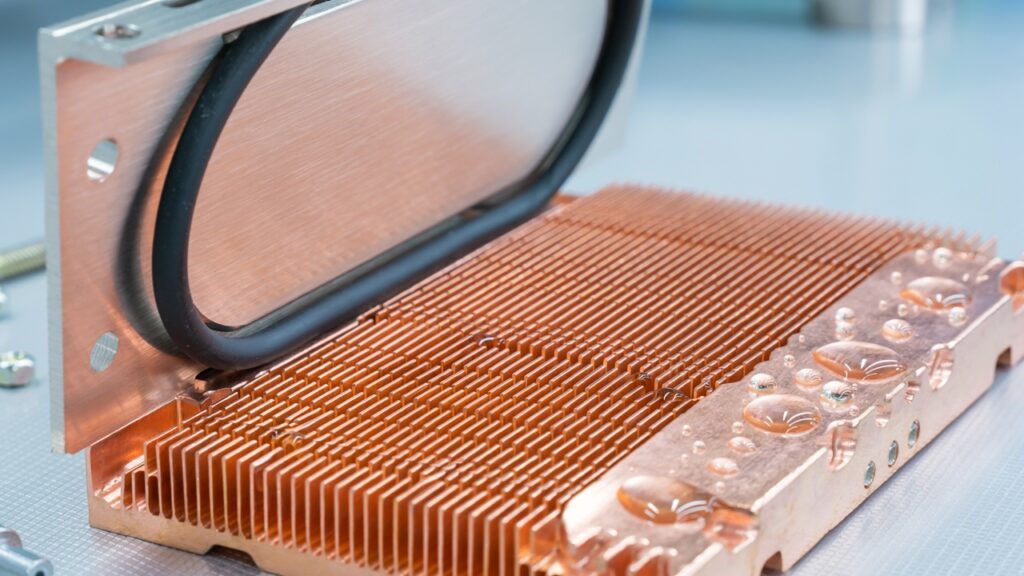
■ Think of Copper Foil as "a Thin Metal Component"
Copper foil looks like a material.
But when it is processed into the required shape,
laminated with insulating material,
and given adhesive,
it becomes a single functional component.
Copper foil has multiple roles:
heat spreading,
electrical conduction,
and EMI shielding.
That is why in metal foil processing, what matters is not simple metal cutting, but understanding which function it will be used for.
■ Using Copper Foil as Wiring for Heat
From near the semiconductor to the enclosure.
From the heat-generating part to the metal frame.
Copper foil is extended long and narrow.
Then heat can be guided to another place.
In other words, copper foil,
like electrical wiring,
may be usable as wiring for heat.
Because the processed shape determines the heat path, it goes well with microfabrication.
■ Copper Foil Also Works for EMI
Metal foil is also used to shield electromagnetic waves.
That is why it can sometimes be given a combined function of
heat dissipation + EMI.
However, the result changes depending on
where it is grounded
and over what area it is placed.
In other words, it may be good for heat but problematic electrically.
Metal foil placement requires looking at both heat and electricity.
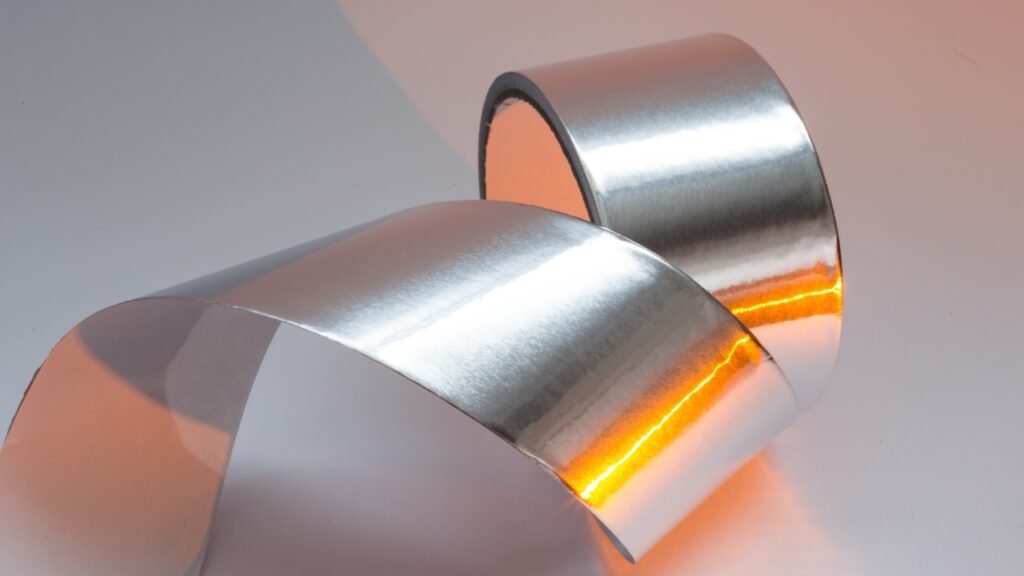
■ Aluminum Foil Delivers Value in Weight Reduction
Although its thermal conductivity is lower than copper’s, aluminum is light.
That is why in
EVs,
aerospace,
robots,
and wearables,
it can be a strong option.
In other words, in metal foil selection, rather than the material that conducts heat best,
it is also important to choose the lightest composition that satisfies the required thermal performance.
■ The Choice Between Copper and Aluminum Is Decided by Overall Optimization
Copper.
High thermal conductivity.
High electrical conductivity.
Heavy.
Aluminum.
Light.
Cost and processability differ.
It cannot simply be said which is superior.
Depending on the application, the optimal point for
heat,
weight,
EMI,
adhesion,
and cost
differs.
Even if the processing company is not in a position to decide the material itself, it can participate in the comparison from the perspective of processability.
■ The Thinner the Metal Foil, the Harder It Is to Handle
Thin copper foil
and thin aluminum foil
have problems such as
folding,
warping,
wrinkling,
and edge curling.
That is why for foils of tens of μm,
not only die accuracy but
transport,
support,
and tension also become important.
■ Edge Quality of Metal Foil Connects to Long-Term Reliability
There are small cracks,
burrs,
or curling
on the edges.
Thermal cycles
and vibration
are repeated.
That part may become the starting point for progressive fracture.
In other words, in metal foil processing,
not only initial dimensions, but edge durability is also important.
■ Summary of Part 1: Insulating Materials, Adhesives and Metal Foils Are Not Supporting Players in Thermal Management
If it were only about releasing heat, choosing a thermally conductive material would be enough. But in actual products, in the same narrow space, stopping electricity, fixing, suppressing noise, and not adding weight are also required at the same time.
Insulating material is not a material to be eliminated. It is a material that establishes the required insulation with as little thermal resistance as possible. That is why we want to make it thinner. But the thinner it gets, the greater the impact of scratches, pinholes and metal burrs.
Adhesive is not a material just for fixing. Applied over the entire surface, it enters the heat path and also traps air bubbles. That is why a structure of non-adhesive directly above the heat source and adhesive only around it is established. And for adhesive strength, stability at the operating temperature matters more than right after application.
Metal foil is involved in multiple functions: heat, conduction and EMI. Extended long and narrow, it becomes wiring for heat. But the thinner it gets, the more folding, warping and small cracks at the edges affect long-term reliability.
In other words, these are not peripheral materials of thermal management. They are constituent materials that establish thermal management as a product.
In Part 2, we look at how to stack them and how far to combine them into a single component.
Column Supervisor: Koji Kakumoto (President, OTIS Co., Ltd.)
After studying abroad and working in planning and development at a trading company, he joined OTIS Co., Ltd. in 2011. While primarily working in the Corporate Planning Department, he has also served concurrently in manufacturing and technical divisions, and since 2018 has served as President, working to drive business growth and strengthen the organization.
This article is a general technical explanation intended for educational purposes and does not refer to any specific company, product, or technology.