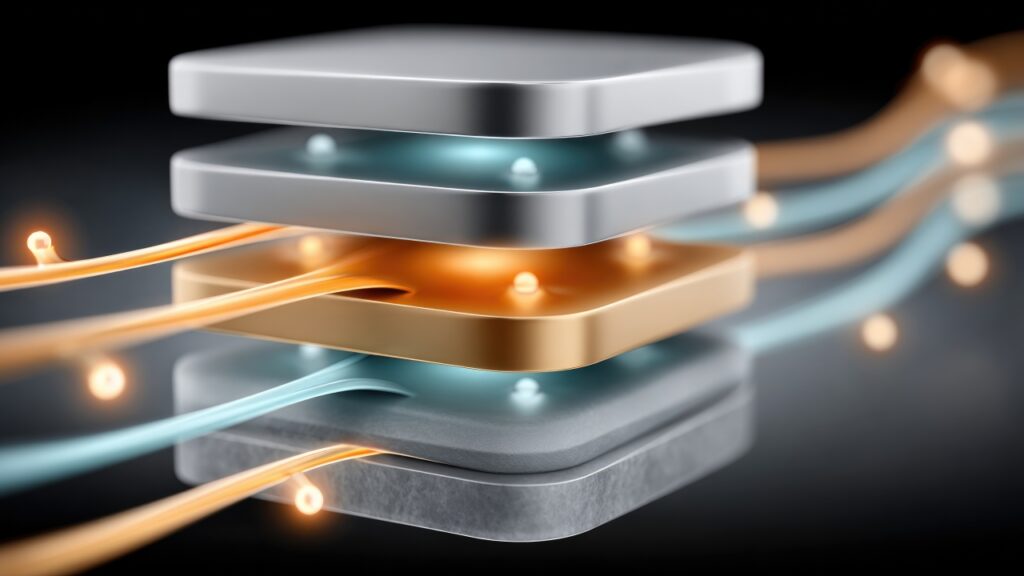
■ What Is Thermal Expansion?
Materials generally expand when the temperature rises and contract when it falls.
How much they expand and contract differs by material.
For example, metals and resins differ in the magnitude of thermal expansion.
Even materials of the same length do not change dimension in the same way when given the same temperature rise.
This difference becomes stress when dissimilar materials are combined.
■ No Problem Alone, but Problems Arise When Bonded
Copper foil alone.
Resin film alone.
If each can expand and contract freely, it is not a big problem.
But when the two are bonded, they can no longer expand freely.
Copper wants to expand this much.
Resin wants to expand more.
But because they are bonded, they pull on each other.
As a result,
the entire laminate may warp.
■ Why Does Warping Occur?
Consider a two-layer structure.
The upper material expands greatly with a temperature rise.
The lower material does not expand much.
But the two are bonded.
The upper side alone cannot become longer freely.
So the whole bends, trying to absorb the difference in deformation of both.
This is the basic idea of warping.
In other words, warping is not merely a processing defect, but also
a physical result of combining different materials.
■ Thinner Materials Can Be More Susceptible to Warping
Thin films and metal foils have low rigidity.
That is why their shape changes easily even under slight stress.
Under conditions where a thick metal plate would hardly deform,
a film of tens of μm can warp greatly.
In other words, making things thinner has the advantages of
being lighter,
saving space,
and making it easier to reduce thermal resistance,
but on the other hand, shape stability becomes harder.
■ The More Layers, the More Complex the Behavior
For example, consider the structure
Graphite
+
Insulating film
+
Adhesive
+
Copper foil
Each material differs in
thermal expansion,
elastic modulus,
thickness,
and hardness.
Furthermore, adhesives behave softly, unlike metals and films.
That is why the way it warps when the temperature changes is not simple.
In other words, the more layers there are, the harder it is to predict the behavior of the finished product from data on individual materials alone.
■ Adhesives Can Also Absorb Stress
Because adhesives are soft, they can play a role in absorbing expansion differences between materials.
Inserting a flexible adhesive layer can sometimes relieve stress more than directly bonding hard materials to each other.
On the other hand, if too soft, other problems occur, such as
shifting,
creeping,
and thickness changes.
In other words, adhesives have the dual role of fixing and absorbing stress.
■ Stronger Bonding Is Not Always Better
To prevent peeling, a very strong adhesive is used.
At first glance, this seems right.
But when the thermal expansion difference between materials is large, the bonded interface cannot move.
Then stress concentrates on
the adhesive layer,
the material body,
and the edges.
As a result, even if the adhesive layer does not peel, cracks may form on the material side.
In other words, high adhesive strength and high long-term reliability are not the same.
■ Delamination Tends to Start at the Edges
In laminated materials, stress tends to concentrate at the edges.
The center is constrained by the surrounding material.
The edges, on the other hand, are free ends.
With repeated temperature cycling, lifting and delamination can gradually progress from the edges.
In other words,
edge shape,
corner shape,
and adhesive area
also affect long-term reliability.
■ Sharp Corners Easily Cause Stress Concentration
Corners of square films.
Narrow notches.
Sharp inside corners.
Stress tends to concentrate in such places.
When subjected to temperature changes or vibration,
cracks,
delamination,
and breakage
can start from there.
That is why, depending on the application, designs that disperse stress, such as rounding corners, are effective.
In other words, outer shape design relates not only to appearance, but also to thermal cycle durability.
■ Special Care Is Needed When Combining Metal Foils and Films
Copper foil and aluminum foil conduct heat well.
On the other hand, insulating films and adhesives have different thermal expansion characteristics.
Laminating these can cause warping and stress when the temperature changes.
Especially with
thin metal foils,
large areas,
and asymmetric lamination,
warping can occur more easily.
In other words, there are cases where adding metal foil to raise heat-spreading performance results in worse shape stability.
■ Asymmetric Lamination Warps Easily
For example, in a structure with
copper foil on only one side
and resin film on the other side,
the upper and lower compositions differ.
Expansion behavior when the temperature changes also differs between top and bottom.
That is why the laminate can warp in one direction.
On the other hand, making the top and bottom as symmetric as possible can sometimes suppress warping.
In other words, in lamination, not only the placement of functions, but also the balance of the structure is important.
■ However, Making It Symmetric Is Not Always Better
Material is added to suppress warping.
But as a result, problems arise:
it becomes thicker,
heavier,
thermal resistance increases,
and cost goes up.
In other words, optimizing only for warping countermeasures can worsen other performance.
Here too, overall optimization is needed.
■ Problems Occur Not Only at High Temperatures but Also at Low Temperatures
Thermal expansion tends to bring high temperatures to mind.
But at low temperatures, materials contract.
For example,
it is assembled at room temperature.
It is taken into a low-temperature environment.
Then the amount of contraction differs for each material.
As a result,
delamination,
stress,
and warping
can also occur.
In other words, what matters is the entire operating temperature range.
■ The Larger the Temperature Difference, the Larger the Stress Tends to Be
For example,
from 25°C to 50°C
and
from 25°C to 150°C
produce different amounts of dimensional change in materials.
The larger the temperature range, the larger the deformation difference between dissimilar materials tends to be.
That is why this is especially important in fields subject to large temperature changes, such as
automobiles,
aerospace,
power electronics,
and semiconductor manufacturing equipment.
■ Thermal Cycles Are Repeated Many Times, Not Just Once
There was no problem after heating once.
That alone is not enough.
In actual products,
starting,
stopping,
charging,
discharging,
day,
night,
summer,
and winter
are repeated.
In other words, materials expand and contract hundreds or thousands of times.
Even if there is no problem the first time, fatigue can gradually accumulate.
As a result, after long use,
delamination,
cracks,
and poor contact
occur.
In other words, thermal cycling is also a fatigue test of materials.
■ Micro-Delamination Worsens Thermal Performance
Even if a laminated interface does not peel completely, part of it may lift.
An air layer forms in this micro-delaminated part.
Then contact thermal resistance increases.
In other words, deformation due to thermal expansion
is not only a mechanical problem,
but leads to the decline of thermal performance itself.
■ It May Cool at First, but Stop Cooling After Several Years
When new, the TIM is in full-surface contact.
Temperature cycles are repeated.
The interface moves little by little due to expansion differences between materials.
Lifting forms in some parts.
Then thermal resistance rises.
Component temperature rises.
In other words,
initial thermal evaluation alone cannot guarantee long-term thermal performance.
■ When Thermal Performance Drops, the Temperature Rises Further
A vicious circle can occur here.
It delaminates.
Thermal resistance rises.
Temperature rises.
The thermal expansion difference becomes even larger.
Delamination progresses.
That is the cycle.
In other words, small interface changes can lead to large performance degradation over the long term.
■ This Is Especially Important in Power Semiconductors
In power modules, different materials are laminated, such as
semiconductors,
ceramics,
copper,
solder,
TIM,
and cooling plates.
Furthermore, because large amounts of power are handled, temperature changes also tend to be large.
That is why thermal expansion differences become an important factor affecting
joint life,
cracks,
and delamination.
■ In EV Batteries Too, Materials Move
In battery packs,
cells,
cooling plates,
insulating films,
gap fillers,
and adhesives
are combined.
Furthermore, the cells themselves may change dimension with charging, discharging and aging.
In other words, in batteries,
in addition to thermal expansion,
the swelling of the cells themselves
must also be considered.
■ Fixing Too Firmly Puts Force on the Cells
If battery cells are fixed firmly, their position is stable.
But when a cell tries to swell, it cannot deform freely.
Then large forces are applied to the cell and surrounding components.
That is why deformation is sometimes absorbed with
cushioning materials,
foams,
and flexible adhesive layers.
In other words, achieving both fixing and deformation absorption is necessary.
■ In AI Servers Too, Warping Changes Contact
In high-performance semiconductor packages, warping can become a problem due to larger size and higher density.
The package warps.
The heat spreader is not perfectly flat either.
TIM is sandwiched between them.
Then TIM thickness and pressure vary by location.
In other words, warping due to thermal expansion can create
variation in contact thermal resistance.
■ In Semiconductor Manufacturing Equipment, It Also Affects Positional Accuracy
If equipment components expand and contract with temperature,
stage positions,
sensor positions,
and jig positions
change.
Here, thermal expansion becomes
not a problem of cooling performance,
but a problem of equipment accuracy.
In other words, the same thermal expansion shows up differently depending on the industry.
■ In Smart Devices, Warping Stands Out Because of Thinness
In smartphones and wearables, materials are thin.
That is why warping of laminated materials may affect
exterior lifting,
display pressure,
and battery interference.
Even warping of a few hundred μm may not be negligible within a product only a few mm thick.
■ The Larger the Area, the Larger the Dimensional Change
Even with the same coefficient of thermal expansion, the longer the original length, the larger the absolute dimensional change.
A 10 mm component and a 500 mm component change dimension by different amounts for the same temperature change.
That is why large-area insulating materials and large gaskets for EVs and the like need
thermal expansion management specific to large areas.
■ Hole Positions Also Change with Temperature
Multiple holes are processed in a large film.
At room temperature, all are per the drawing.
But at high temperatures, the entire film expands.
The distances between holes also change.
This differs from the amount of expansion on the metal case side.
Then hole positions may not line up during assembly or use.
In other words, for large-area components, it is necessary to look not only at the outer shape but at temperature changes in the pitch between holes.
■ The Hardness of Adhesives Also Changes with Temperature
Adhesives can become softer at high temperatures.
They can become harder at low temperatures.
That is why, depending on temperature,
stress absorption capacity,
fixing strength,
and creep
change.
In other words, even with the same laminated structure, how force is transmitted changes with temperature.
■ Creep at High Temperature Can Shift Position
When kept at high temperature for a long time, adhesives can deform little by little.
When
the component’s own weight,
stress from thermal expansion,
and vibration
are applied, the position may move little by little.
This misalignment can also affect
contact area,
insulation distance,
and seal position.
■ At Low Temperatures, Conformability Can Decrease
At low temperatures, adhesives harden and flexibility can decrease.
Then
it becomes harder to absorb thermal expansion differences,
stress concentrates on impact,
and it may peel more easily.
In other words, material evaluation at room temperature alone is not enough.
■ Combining Vibration and Thermal Expansion Makes It Even More Severe
In EVs,
robots,
and aircraft,
there is vibration in addition to temperature changes.
Vibration is received while stress from thermal expansion is applied to the interface.
Then delamination and cracks may progress more easily.
In other words, in actual products, there are cases where it is necessary to look not at heat-only tests, but at reliability in combined environments.
■ Just Changing the Orientation of the Material Can Change Behavior
Films can differ in mechanical properties and dimensional change depending on the manufacturing direction.
They expand differently in
the machine direction
and the transverse direction.
That is why warping and dimensional change of the finished product may change depending on the material cutting direction.
In other words, even with the same material and the same shape, the cutting direction can become a performance condition.
■ Tension During Processing Can Also Create Residual Stress
In reel-to-reel processing, material is processed while tension is applied.
It is laminated while pulled strongly.
Then the tension is released.
The material then tries to shrink.
Stress may remain between it and its lamination partner.
In other words, the cause of warping is not only temperature changes during use.
The manufacturing process itself can also create residual stress.
■ Warping Also Changes with Lamination Conditions
If the
pressure,
temperature,
speed,
and tension
during lamination change, the stress state of the finished product also changes.
Even with the same material composition, warping can differ depending on processing conditions.
In other words, for laminated components,
material design and lamination conditions cannot be separated.
■ Failure Example: Copper Foil Was Added, and Heat Decreased, but the Component Warped
To improve heat spreading, copper foil was added to a film component.
Thermal performance improved.
But after temperature evaluation, the component warped greatly.
Part of the applied surface lifted.
As a result, long-term thermal performance actually worsened.
In other words, only thermal conduction performance was improved, without looking at the thermal expansion difference of the laminated structure.
■ Failure Example: Passed Initial Evaluation, Delaminated After Thermal Cycling
In evaluation right after prototyping,
thermal performance,
insulation performance,
and adhesive strength
were all fine.
But after thermal cycle testing, delamination occurred from the edges.
The cause was repeated stress from the expansion difference between dissimilar materials.
In this example, making the adoption decision based only on initial performance led to failure.
■ Failure Example: Hole Positions of a Large-Area Film Stop Lining Up
A large insulating film was processed at room temperature.
It also passed dimensional inspection.
But when trying to assemble it to a metal case at high temperature, the hole positions shifted.
The amounts of expansion of the film and the metal differed.
In other words, the processed dimensions were correct, but the dimensions at operating temperature were not.
■ The Researcher's Perspective: Consider the "Constrained State," Not Material Properties
The coefficient of thermal expansion is a property of the material alone.
In actual products, however, materials cannot expand and contract freely.
They are bonded.
They are fixed with bolts.
They are sandwiched between other materials.
In other words, what matters is
how that material is constrained within the actual structure.
Even with the same material, if the constraint conditions change, the stress generated also changes.
■ The Shop-Floor Perspective: When Warping Is Found, Do Not Suspect Only the Material
A laminated component warped.
At this point,
it is too early to conclude
“the film is bad.”
What one wants to check is
the material composition,
the thickness balance between top and bottom,
the cutting direction,
lamination tension,
processing temperature,
and storage conditions.
Warping is often caused by a combination of multiple conditions.
■ Dimensional Inspection Should Also Be Aware of Usage Conditions
Dimensions are measured right after processing.
Per the drawing.
But the environment in which the customer uses it is 80°C.
Or minus 20°C.
In this case, it is necessary to consider whether room-temperature dimensions alone are sufficient.
Depending on the application, it is worth checking even dimensional changes assuming the operating temperature.
■ OTIS's Perspective: Dissimilar Material Lamination Is an Area Where OTIS's Expertise Shows
In thermal management,
TIM,
graphite,
copper foil,
insulating films,
and adhesives
are sometimes combined.
But the moment materials are laminated, new problems arise:
thermal expansion differences,
warping,
delamination,
and thickness tolerance.
In other words,
laminating materials is not just adding functions, but also designing the relationship between materials.
This is an area where processing companies that perform high-precision lamination can deliver value.
■ Checking Material Combinations at the Processing Stage
For example,
will warping not become large with this copper foil thickness?
Can this adhesive absorb the stress?
Will this composition not be stronger on just one side?
Such perspectives are held from the prototype stage.
Because material manufacturers’ data alone cannot answer these, it is also important to actually laminate and evaluate.
■ Fixing Processing Conditions Is Also Volume Production Quality
Even with the same material composition, if
lamination pressure,
tension,
speed,
and temperature
change, the state of the finished product can change.
That is why, in volume production, it is necessary not only to control dimensions, but
to stabilize the processing conditions themselves.
This is an important part of turning material performance into volume production performance.
■ What OTIS Can Do
At OTIS, through
● Lamination of dissimilar materials
● High-precision lamination
● Thin-film processing
● Metal foil processing
● Insulating film processing
● TIM processing
● Graphite processing
● Adhesive processing
● Partial lamination
● High-precision die-cutting
● Processing that considers material cutting direction
● Tension control for long-run processing
● Dimensional and positional accuracy control
● Transfer from prototyping to volume production conditions
we can bring functional components that combine dissimilar materials closer to volume production.
OTIS cannot change the coefficient of thermal expansion of materials themselves.
However, it is possible to bring components closer to a state where thermal expansion differences are less likely to become a problem, through material composition, shape, lamination and processing conditions.
■ Outside OTIS's Expertise
OTIS is not a company that specializes in
● Developing the coefficient of thermal expansion of materials themselves
● Resin formulation design
● Stress analysis of entire semiconductor packages
● Dedicated CAE thermal stress analysis
As needed, we work with material manufacturers, analysis companies and customers’ design departments.
Within this, OTIS plays the role of bringing things closer to a volume production state as actually laminated and processed components.
■ Summary: Thermal Management Materials Move When the Temperature Changes
In thermal management, attention tends to go to thermal conductivity and thermal resistance.
But the materials themselves also expand and contract with temperature.
Copper.
Aluminum.
Resin.
Film.
Adhesive.
Each moves differently.
When these are bonded, stress arises inside every time the temperature changes.
As a result,
it warps,
peels,
cracks,
the contact state changes,
and thermal performance drops.
That is why, when combining dissimilar materials, initial thermal performance is not enough.
Can the shape, contact and position be maintained even after the temperature changes?
It is necessary to check this far.
Thermal management materials appear to be still.
But every time the temperature changes, the materials are pulling on each other inside.
That is why, to establish long-term thermal performance,
it is important to design not only how heat flows, but also how materials move.
Column Supervisor: Koji Kakumoto (President, OTIS Co., Ltd.)
After studying abroad and working in planning and development at a trading company, he joined OTIS Co., Ltd. in 2011. While primarily working in the Corporate Planning Department, he has also served concurrently in manufacturing and technical divisions, and since 2018 has served as President, working to drive business growth and strengthen the organization.
This article is a general technical explanation intended for educational purposes and does not refer to any specific company, product, or technology.