■ Why Is Lamination Important in Thermal Management?
In thermal management, it is difficult to give a single material all functions.
For example, graphite excels at spreading heat.
But it is conductive.
So an insulating film is stacked on it.
Furthermore, adhesive is added to fix it to the product.
In other words, the composition becomes
Graphite + Insulating film + Adhesive
The customer could also apply each one separately.
But processes increase.
Positional deviation increases.
The number of applications increases.
So they are integrated in advance at the processing stage.
This is a major role of lamination.
■ Lamination Turns "Materials" into "Components"
Graphite alone is a material.
Insulating film alone is also a material.
Adhesive alone is also a material.
When they are integrated in the required positional relationship,
they become a single component with multiple functions:
spreading heat,
insulating,
and adhering.
In other words, lamination can also be called a process that converts different material performances into a single component performance.
■ If the Position Shifts, the Function Shifts
For example, consider the structure of
covering the perimeter of graphite with insulating film.
The insulating film shifts by 0.5 mm.
Then the graphite is exposed on one side.
On the opposite side, there is excess insulating film.
In other words, positional deviation is not just an appearance problem.
It becomes a positional deviation of the insulation function itself.
■ In Thermal Management, Lamination Position Determines the Heat Path
For example, graphite is stacked on only part of the TIM.
That position shifts.
Then heat has difficulty entering the graphite from the heat source.
Or heat spreads to unintended places.
In other words, lamination position becomes a design dimension that determines the entrance and exit of heat.
■ Positional Tolerances of Multiple Materials Stack Up
Material A is applied at ±0.2 mm.
Material B is also ±0.2 mm.
Material C is also ±0.2 mm.
Each looks like a small error on its own.
But in the final component, the relative position of A and C may shift significantly.
In other words, in high-precision lamination, it is necessary to look not at the positional accuracy of each layer, but at
the final positional accuracy between functions.
■ Where to Place the Reference Is Important
Outer shape reference.
Hole reference.
Recognition mark reference.
Carrier reference.
The final positional accuracy changes depending on what each material is aligned to.
For example, if what the customer values is the central opening, using the central opening as the reference may be more rational than the outer shape.
In other words, in high-precision lamination, it is important to work backward from function to decide what to use as the reference for lamination.
■ Films Do Not Stack Easily
Two hard metal plates are stacked.
They are relatively stable.
But thin films
stretch,
sag,
move due to static electricity,
and wrinkle.
That is why even if positions are simply aligned, they may change during lamination.
In other words, thin-film lamination requires both the technology to align and the technology to maintain the aligned state.
■ Tension Affects Positional Accuracy
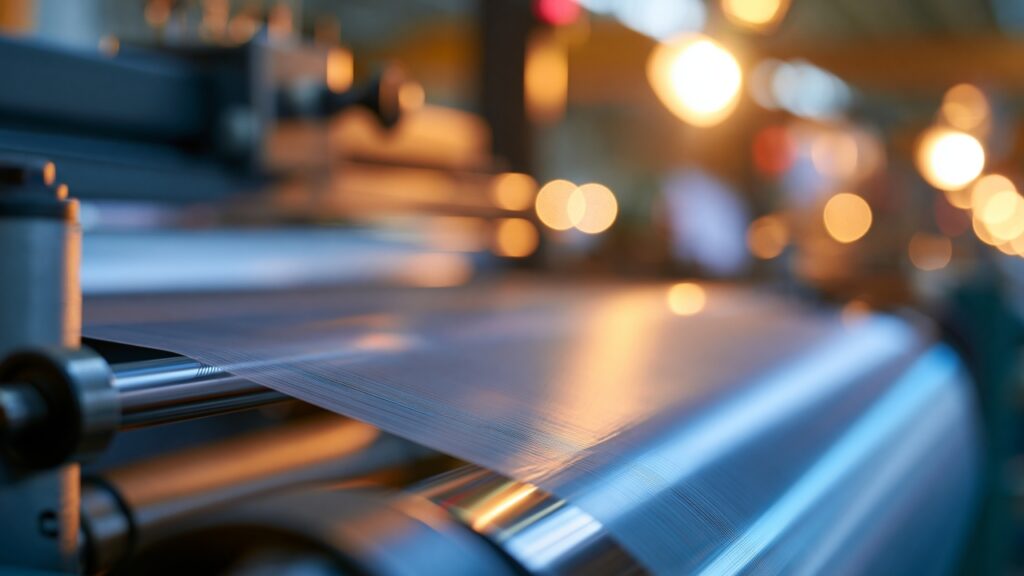
Roll materials are laminated while being transported.
The upper material has strong tension.
The lower material has weak tension.
Then after bonding, one tries to shrink.
As a result,
warping,
positional deviation,
and wrinkles
may occur.
In other words, in lamination, tension balance becomes shape quality.
■ Keeping Tension Constant Is Not Enough
Material A and material B differ in
thickness,
elastic modulus,
and elongation.
Even with the same tension, the amount of elongation is not the same.
That is why, rather than
the same tension as a number,
appropriate tension for each material
must be set.
■ Roller Pressure Is Also Important
In lamination, materials are pressed together with rollers or presses.
If the pressure is too weak,
insufficient adhesion,
air bubbles,
and lifting
occur.
If too strong,
soft materials are crushed,
adhesive squeezes out,
and thickness changes.
In other words, what is needed is not the strongest pressure, but pressure that can stably create the required contact.
■ Uniform Pressure Distribution Is Also Important
Pressure is high only in the center of the roller.
The edges are weak.
Then the state becomes
firmly bonded in the center,
lifted at the edges.
The impact is especially large in large-area lamination.
In other words, it is necessary to look not only at average pressure, but at pressure uniformity across the surface.
■ Results Also Change with Roller Hardness
Soft rollers
and hard rollers
differ in conformability to materials.
Soft rollers conform easily to steps.
On the other hand, they may locally deform the material.
Hard rollers make flatness easier to achieve.
But absorbing steps is difficult.
In other words, in lamination, equipment specifications must also match the material composition.
■ The Bonded State Changes with Speed
Laminating slowly.
The adhesive has time to conform to the surface.
Speeding up.
Takt time improves.
But air is harder to release.
The adhesive does not wet out sufficiently.
This can happen.
In other words, between
prototyping speed
and volume production speed,
results may change even with the same material.
■ In Volume Production, What Matters Is Not "the Speed at Which It Can Be Bonded" but "the Speed at Which It Can Be Bonded Stably"
Raising speed raises productivity.
But if
air bubbles,
wrinkles,
and positional deviation
increase, it is meaningless.
What matters is not the maximum speed.
It is creating a speed range in which quality can be maintained.
■ Air Bubbles Are a Typical Lamination Challenge
When films are bonded together, air can become trapped inside.
In thermal management components, these air bubbles may become thermal resistance.
In insulation applications, they also become local structural non-uniformities.
In other words, air bubbles are not only about appearance, but quality problems related to heat, insulation and durability.
■ There Are Reasons Where Air Bubbles Form
They remain in the center.
They remain around steps.
They remain near openings.
This is sometimes not a coincidence.
Places where air has difficulty escaping are created by
application direction,
pressing angle,
adhesive flowability,
and material flatness.
In other words, in air bubble countermeasures, it is necessary to design where the air escapes to.
■ Bonding Sequence Is Also Important
A large-area film is bonded over the entire surface at once.
Air remains in the center.
It is bonded sequentially from the edge.
Air is easier to release outward.
In other words,
from which direction
and in what order lamination is done also affects quality.
■ Air Is Sometimes Released Through Partial Openings or Slits
With full-surface adhesive, air has difficulty escaping.
So
openings,
fine slits,
and non-adhesive areas
are provided.
This can sometimes make it easier to release air during application.
In other words, microfabrication and lamination are not separate technologies.
Lamination performance can be improved through processed shapes.
■ Partial Adhesion Is Also Effective
When full-surface fixing is not needed,
adhesive is placed only where needed.
Only the perimeter.
Only a few points.
That is the structure.
Then
fewer air bubbles,
lower thermal resistance,
and improved peelability
can sometimes be achieved.
In other words, in high-precision lamination, even where to bond becomes a design target.
■ Thermal Expansion Differences Between Dissimilar Materials Create Warping
Copper foil.
PET.
PI.
Graphite.
Adhesive.
Each has a different coefficient of thermal expansion.
These are bonded together.
The temperature changes.
Each material expands and contracts by a different amount.
But because they are bonded, they cannot move freely.
As a result, the laminate may warp.
In other words, lamination is also a process that integrates materials while at the same time constraining them against each other.
■ Even If Flat at Room Temperature, It May Warp at High Temperature
Right after processing.
Flat.
Dimensions also pass.
But it is heated to 80°C.
It warps.
It returns when cooled.
Or it does not fully return.
This happens.
In other words, lamination quality cannot be judged right after processing alone.
It is necessary to consider even shape stability at the operating temperature.
■ Asymmetric Laminates Warp Easily
In a laminate with
metal foil on only one side
and only film on the other side,
the top and bottom compositions differ greatly.
That is why the balance of thermal expansion and residual stress is easily lost.
To suppress warping,
material thickness,
adhesive,
and lamination order are sometimes adjusted.
In other words, structural symmetry is also a design element.
■ There Is Also Residual Stress from Lamination
Bonding while applying temperature.
Applying tension.
Applying pressure.
It is fixed in that state.
After processing, the conditions are released.
Then the material tries to return to its original state.
This residual stress may lead to
warping,
delamination,
and dimensional change.
In other words, the shape of the finished product depends not only on material composition but also on processing history.
■ In High-Temperature Lamination, the Cooling Process Is Also Important
Lamination is done with heat.
The material softens.
It bonds in that state.
Then it cools.
The material contracts during cooling.
If the constraint state is non-uniform at this time, it leads to warping and positional deviation.
In other words, not only heating conditions, but even cooling conditions are part of the process.
■ Adhesive Thickness Also Affects Positional Accuracy
The soft adhesive layer is thick.
Then the material can move slightly after lamination.
At high temperatures, it becomes even softer.
A load is applied for a long time.
The position shifts.
This may happen.
In other words, lamination positional accuracy may change not only during processing but also during use.
■ Adhesives Also Have the Role of Stress Relaxation
On the other hand, a soft adhesive layer can absorb stress between dissimilar materials.
With a hard adhesive layer, stress concentrates.
A soft layer absorbs movement.
In other words, adhesives sometimes function not only as fixing materials but also as stress relaxation materials.
■ Bonding Strongly Is Not the Answer
A high-adhesion adhesive is used.
It is hard to peel.
But it cannot release expansion differences, and stress is applied to the material body.
Conversely, if too soft,
the position moves.
In other words, in lamination, it is necessary to look at the balance of
adhesive strength,
flexibility,
and thermal performance.
■ Each Additional Bonding Interface Also Changes the Heat Path
For example, a structure of
Heat source
↓
Adhesive layer
↓
Graphite
↓
Adhesive layer
↓
Enclosure
Even if the adhesive layer is needed for fixing, it may become resistance in the heat path.
In other words, through combining,
processes decrease,
but thermal resistance increases.
This can happen.
That is why in laminate structures, it is necessary to consider whether each layer is really needed.
■ "Stacking Only Where Needed" Rather Than "Stacking Everything"
Graphite over the entire surface.
Insulation over the entire surface.
Adhesive over the entire surface.
That seems simple.
But it becomes
thick,
heavy,
higher in thermal resistance,
and higher in cost.
So
graphite only where needed,
insulation only at the high-voltage area,
adhesive only on the perimeter.
In other words, in high-precision lamination, it is important to differentiate functions within the surface.
■ Partial Lamination Has a Large Point of Contact with OTIS
Partial lamination requires high positional accuracy, such as
material A only here,
material B only at this position.
It is more difficult than simply bonding entire roll surfaces.
But in return, it may lead to
material reduction,
thinning,
weight reduction,
and lower thermal resistance.
In other words, partial lamination is an area where a processing company’s proposal value easily emerges.
■ Multilayering Accumulates Thickness Tolerances
Film 50 μm.
Adhesive 25 μm.
Graphite 40 μm.
Insulating material 25 μm.
Total 140 μm.
But each material has a thickness tolerance.
As layers increase to four or five, the variation in final thickness may also increase.
This thickness difference affects
contact pressure,
assembly clearance,
and thermal resistance.
In other words, in laminated components, total thickness control is important.
■ Sometimes It Is Die-Cut Further After Lamination
Materials are laminated first.
Then the finished outer shape is die-cut.
This method can sometimes make it easier to align the outer shape of each layer.
On the other hand, because
adhesive,
metal foil,
and graphite
are stacked together, die-cutting difficulty may increase.
In other words, the process order of whether to die-cut first or laminate first is also important.
■ Summary of Part 1: Lamination Is a Process That Stacks Materials and Constrains Them at the Same Time
Thermal management components are not established with a single sheet.
Graphite spreads heat but is conductive.
That is why insulating film is stacked on it, and adhesive is added for fixing.
But stacking is not completion.
If the position shifts by 0.5 mm, graphite is exposed on one side.
That is not an appearance defect, but a positional deviation of the insulation function.
If tension balance is lost, warping and wrinkles appear.
If pressure is weak, air bubbles remain; if strong, adhesive squeezes out.
If speed is increased, air cannot be fully released.
Furthermore, stacked materials can no longer move freely.
Bonding materials with different coefficients of thermal expansion causes warping when the temperature changes.
Even if flat at room temperature, it may warp at 80°C.
And each additional interface increases thermal resistance.
Even if processes decrease, the heat path can get worse.
Thickness tolerances of each layer also change contact pressure when they accumulate.
In other words,
lamination integrates materials while at the same time
constraining them against each other and creating new interfaces.
Then in what order should that laminate be made,
and how far should it be integrated?
In Part 2, we look at this from the perspective of process design.
Column Supervisor: Koji Kakumoto (President, OTIS Co., Ltd.)
After studying abroad and working in planning and development at a trading company, he joined OTIS Co., Ltd. in 2011. While primarily working in the Corporate Planning Department, he has also served concurrently in manufacturing and technical divisions, and since 2018 has served as President, working to drive business growth and strengthen the organization.
This article is a general technical explanation intended for educational purposes and does not refer to any specific company, product, or technology.